Two women in my extended family made it to 100 years old. One had children; the other did not. But when they celebrated their centennial birthdays, both were surrounded by loving family.
![]() |
|
| Edna Sousa at 100 |
Two women in my extended family made it to 100 years old. One had children; the other did not. But when they celebrated their centennial birthdays, both were surrounded by loving family.
![]() |
|
| Edna Sousa at 100 |
Dear friends,
It’s the second anniversary of my husband’s death. Although I promised myself to stay zen about it, the memories and grief are weighing me down today. So I’m going to share a few things off the web that give me comfort.
TheNotMom.com tells us about a new report by a Harvard researcher that shows there are more households in the United States without children than with. So if you don’t have kids, you are not out of the ordinary. The report itself is a little harder to understand, but you can read it here.
There’s a new book out by comedian Jen Kirkman called I Can Barely Take Care of Myself: Tales From a Happy Life Without Kids.” It sounds like fun. They’re talking about it on The View today.
Finally, I have probably mentioned it before, but the Gateway-women gallery of childless role models at Pinterest can keep you reading all day about marvelous, beautiful women who never had children. By the way, I’m in there, and I’m thinking: what should I do with my hair? 🙂
Have a wonderful day.
What to Expect When No One’s Expecting: America’s Coming Demographic Disaster by Jonathan V. Last, Encounter Books, 2013.
After years of hearing that we have too many people on this planet and that we have to decrease our population, here comes Jonathan V. Last to tell us that if we don’t start having more children, we’re in trouble. We’ll have a population of old people with no young ones to support them. Other authors tell us the exact opposite. Whom should we believe? This book is a slow read, a scholarly compilation of statistics that show the birth rate going down below replacement level in most first-world countries. Last blames it on many factors of modern life, including the cost of raising children, women going to college and having careers instead of babies, the decline of marriage and religion and the general belief that having children will take all the fun out of life. He details the efforts, mostly unsuccessful, that have been made to encourage people to have more children and makes suggestions for how to encourage more births. Last has a strong conservative bias and occasionally laces this footnote-fest with sarcasm, but there’s a lot of interesting information here, and it certainly provides food for thought.
There’s no doubt the birth rate has been going down. In some countries, such as Germany and Japan, the population is shrinking at a rapid rate. The question is whether this is a problem. I had this book with me at the doctor’s office a couple days ago. When I showed my doctor the cover, she exclaimed that a smaller population is a good thing, that this world has too many people in it. That’s what most people think. Just visit any large American city at rush hour. Wouldn’t fewer people and more open space be good? Yes, we’d have to work out how to manage things like Social Security with fewer workers contributing to it, but wouldn’t it even out in time?
And how does this affect our individual decisions on whether or not to have children? Certainly overpopulation is often cited by the childfree crowd as a good reason not to have kids. If we’re to believe Jonathan V. Last, anyone who has more than two children should be rewarded with tax breaks and other incentives. But Laura Carroll maintains in The Baby Matrix, reviewed here in February, that couples should be given tax breaks for NOT having children.
So what’s the answer? I think if you want to have children, you should have them, and if you don’t want them, don’t have them. The population will sort itself out.
What do you think?
“We could have been parents: the conversation that changed our lives” is the title of an article in the UK’s Guardian that almost could have been written about my husband and me. The writer, Ruth Wishart, says she didn’t bring up the subject of having children until she and her husband Rod had been married for two years. She just assumed they would have kids. When she started talking about when to have them, she found out he didn’t want to have children at all. Happy with her life and career at the time, she let it go. Eventually she had her tubes tied. Then the unexpected happened: When she was in her 50s, her husband died suddenly, leaving her feeling very much alone.
I’ll let you read the article for the details, but so much of this story is familiar. As you can read in my Childless by Marriage book, Fred did tell me before the wedding that he didn’t want to have any more children, that the three he had from his first marriage were enough for him. He told me how he felt, but I really didn’t talk about how I felt; I assumed he would change his mind. We didn’t have the conversation we should have had. Instead, I let it go, too. And like Ruth’s husband, mine died. So here I am with my dog.
I’m not looking for sympathy at this point. My life is pretty good. What I’m saying is the same thing I have been saying here for years: For God’s sake, talk about it. Even if it causes a fight or sours the relationship, don’t hold it in. If you want children, say so. If you don’t want children, say so. If you’re not sure or might be willing to compromise, say so. Talk it out. Don’t let it fester, and don’t let yourself get caught in a situation that breaks your heart. Please.
Thank you to Beth at the Children or Not blog for letting us know about this article.
I welcome your comments.
“Are You Grieving Over Your Lack of Children?” is the headline of the blog I posted here on Nov. 7, 2007. Since August 2007, I have published 366 other posts at this site, but that is the one that has drawn the most views–6873–and the most comments–152. Most people get to it by a Google search. I’m thinking they’re searching through tears because the key word is “grief.” It hurts to want children and not be able to have them, especially when it seems to be a normal part of life for everyone around you. You see other people cuddling babies and it hurts. You see your friends and sisters getting pregnant and it hurts. You see a child laboring over a Mother’s Day card for his mom, and it hurts. You see an older woman going out to lunch with her daughter and granddaughter, and it hurts. I know. I feel that pain, too.
The comments keep coming in for that post, as well as for many others. People, mostly women, write to me in crisis. In so many cases, they thought they would have children with their spouse or partner, but now he/she is saying no, they don’t want to do it. Maybe they already have children from a previous marriage and feel that’s enough. Maybe they’ve had a vasectomy. Maybe one or both people have fertility issues. Maybe they just didn’t get serious about it until they were in their 40s and now it’s too late. Often, the writer, again usually a woman, is having to make an impossible choice: the man she loves or the children she’s always wanted.
I’m not a psychologist or marriage counselor; I’m a writer. I know a lot about this subject because of my own experiences and a boatload of research. I include much of that research as well as my own story in my Childess by Marriage book. I continue to collect all the information I can about all aspects of life without children and will share as much as I can. I offer my love and prayers in the hope that we can all find peace with what feels like a hole in our lives. If we can help dry each other’s tears and ease each other’s grief, then this blog is worthwhile.
Thank you all for being here. Keep coming back.
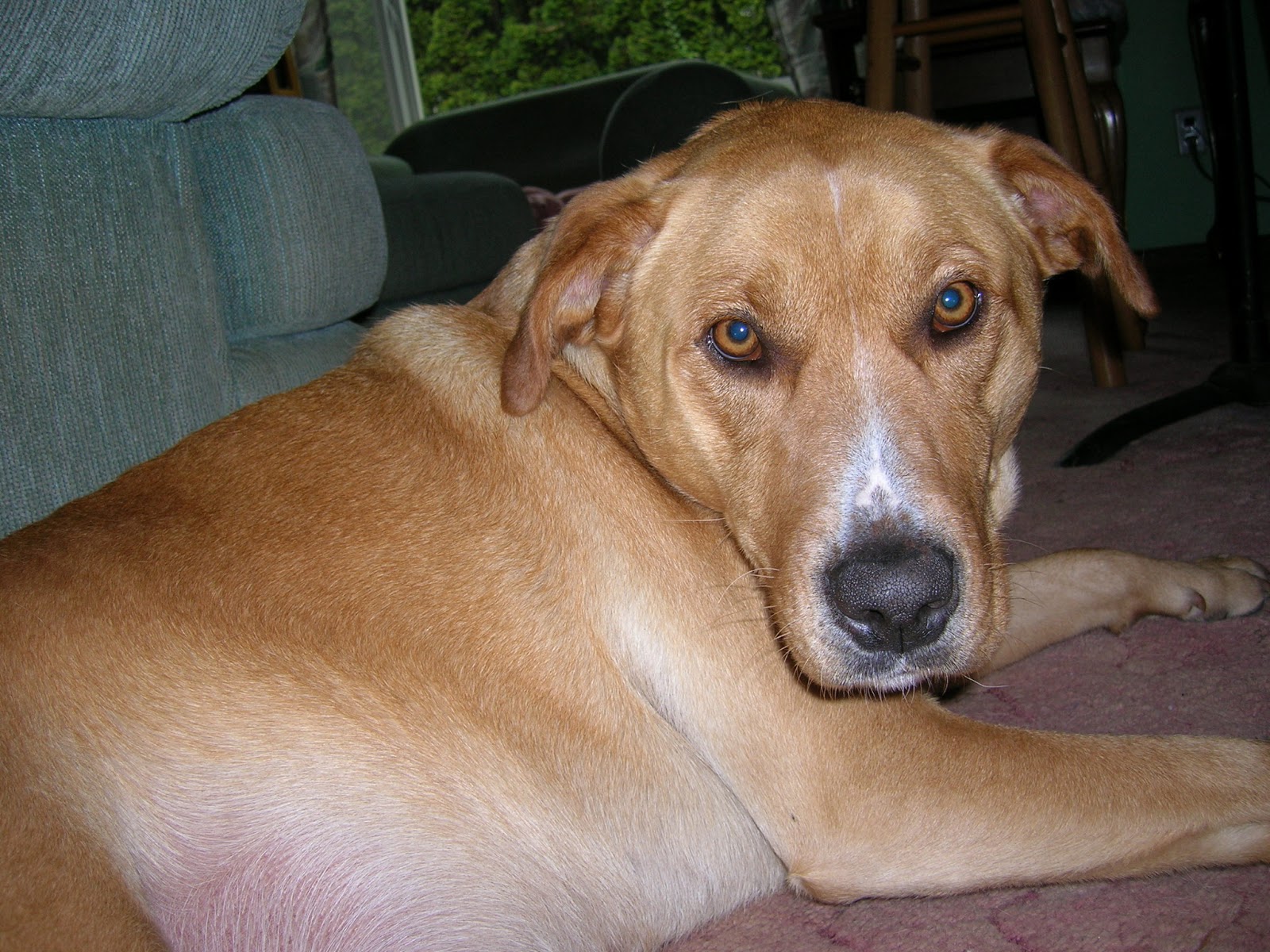
I’ve been mothering my dog today. She has yet another ear infection, despite repeated home treatment. The doctor pointed to her floppy ears and said she’s a “poster child” for ear infections. Sunday, she started scratching her ears and shaking her head, sulking in misery in-between. I kept looking at her ears and couldn’t see the problem, but it was worse yesterday, so I called the vet first thing this morning. Out with the work schedule. Annie is more important. I have some things I should see my own doctor for, but not when my baby is hurting.
Annie is always happy to go for a ride, but as she began to realize where we were going, she started shaking. I drove with one hand and held her with the other. At the vet’s office, she ran up to the counter and greeted the receptionist. Then she leaped onto the padded seat to sit next to me, putting her paws in my lap and her head on my shoulder. She was trembling. I held her and tried to reassure her, especially when other dogs cried out from beyond the closed door.
Finally it was her turn. I told the lady vet about Annie’s symptoms and what I had been doing for them. I held my dog as an aide took her temperature and the doc swabbed gunk out of her ears to have it analyzed. I got instructions for medicine and ear wash, and we talked about Annie’s diet because my pup’s getting a little chunky. I’ve been giving her too much chow. Am I measuring her food, the vet asked. Uh, no. This diet is going to hurt me more than it does my dog.
Annie gobbled a few dog cookies, I paid the bill, and we walked out together, her tail wagging, my bank account bruised. I foresee a lot of difficult sessions getting medicine into Annie’s ears, but I will do it. I will let her shake goo all over my clothes, just as I let her lick my face and jump in my lap–all 81.5 pounds of her–because I love her, and it’s my job to take care of her.
If that isn’t mothering, what is?
In my last post, I talked about not letting Easter get to you with its emphasis on children. Well, Easter got to me, but not in the way I expected. There were children around, and they were as adorable as expected. Children with their choir-singing parents, children getting baptized, tots trying to sing in the back of the church, pictures all over Facebook of families with kids. That was fine. But there came a moment last night in the third of the four long services that I sang and played for when we were once again remembering our loved ones who had died. I fixed on my mother and felt a connection. I felt as I often do that I am a direct continuation of her too-short life. Not only do I look like her and carry on many of her beliefs and ways, but I’m taking her life force beyond what she was able to do, in my work as a writer and musician, in my life with my dog here in the woods, and in the adventures I go on.