Loving mom’s Facebook post sets me off

I’m scrolling through Facebook and here comes one of those picture posts with a saying about the glory of motherhood. This one proclaims, “Having a daughter is God’s way of saying, ‘Here. I thought you could use a lifelong friend.’” It goes on to say, “I love my daughter with all my heart. Share if you do too.”

Just jam a knife into my heart. I’ve gotten this one twice this week from women I love and whose daughters I cherish, but who don’t understand how these posts affect women who never had children. They have every right to glory in their children and I’m happy for them, but it hurts and I’m not sure how to react. Not having a daughter, I can’t “share.” Do I “like” it when I have trouble even looking at it? Do I try in the comments to explain how it makes me feel? In at least one case, I don’t dare. One friend would send me a hug, but the other would scold me for whining and tell me it’s my own fault if I don’t have kids.

Is it? Hello, God? Is it my fault? Did I free-will myself out of motherhood? Should I have stopped using birth control in a failing marriage? My husband would have noticed; he was vigilant about making sure we didn’t get pregnant. After that, should I have not married a wonderful man with three kids and a vasectomy in case someone else showed up to give me children? I have never met any other possibilities.

I was young. I didn’t want to be alone. I didn’t know all this would happen. I thought I could still be a mom right up until I realized it was too late. That caused me to drink a lot for a while. It took another decade before I could say the words, “I will never be a mother.” So it’s my fault?

No. I don’t want to “like” this post, and I am not going to comment, so I scroll past and read some more junk about Trump and Clinton. Let my loved ones assume I was busy and missed their posts.

To be honest, my initial reaction to the Facebook post was a wistful “if only.” Then I got mad.

Today there was a different post: “Share if you have a handsome son.” Uh, next. We’ve all seen them, the shout-outs for daughters, sons, granddaughters and grandsons. Good for them. I’d probably post the same things if I could. I’d be disgustingly proud of my kids. I’m bad enough posting pictures of my dog.

Okay. Thanks for letting me vent. My life is good. I’m out to lunch, the ocean view is gorgeous, and my Caesar wrap is delicious. Also, the kid in the next booth is driving me nuts. She won’t stay in her chair. She is not eating her kid-size fish and chips. At least I don’t need to deal with that. So what if I’m eating alone? The book I’m reading is great.

Two old women in sweatshirts and jaunty hats pass by. They’re laughing. I can be like them.

Keep saying it: My life is good. My life is good. My life is good.

Whew. See what one little Facebook post can do? Okay readers, what sets you off?
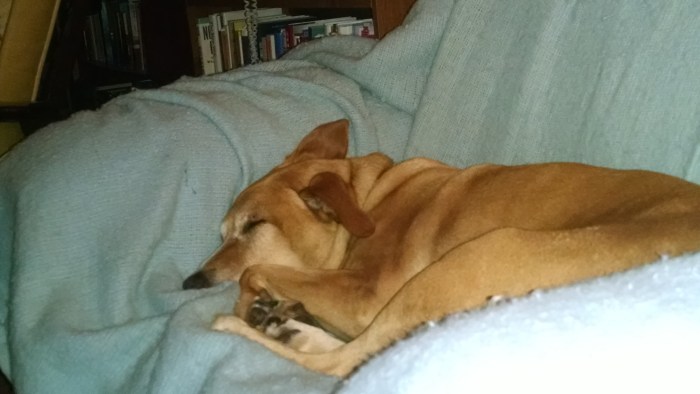
Dog who is NOT my baby visits the vet

Last week I wrote about my dog Annie and how she’s not my baby, not a substitute for children. Well, my not-baby and I went to the vet yesterday. Annie has been limping pretty badly on one front leg and one back leg. She also has a lump on her left front shoulder that seemed to have grown since our last vet visit. I was afraid of cancer. I also feared she would need knee surgery. Not that she showed any problems as she jumped around the waiting room greeting everyone.

It was a long visit, involving an extensive exam, blood tests and biopsying the lump. Good news. The lump is a benign lipoma—fatty tissue. The knee is fine. It’s her hips that are wearing out. And her weight making it worse. Ms. Annie is now on a diet because “Mom” has been giving her too many treats. Time for “tough love,” the vet says. I have some new drugs for me to hide in her food and a bill for $285. Feels like parenting, but I am still not my dog’s mother.

I was proud of my baby, no, friend, no, companion, no, partner, at the vet’s office. Huddled between my legs in the waiting room, trembling with nerves, she behaved perfectly. She didn’t even try to murder the two poodles who came in and whined the whole time. She just barked once at each dog to let them she was there.

She poured on maximum cuteness as she pulled me down the hall trying to greet every doctor and aide that we passed. In the examining room, she set her massive paws on the counter where she knew the cookie jar sat. “She’s so cute,” the vet’s assistant kept saying. I know. Her body might be 8 ½ years old and her joints starting to go bad like mine, but she’s a puppy at heart and she loves people. Thank God that lump was nothing life-threatening.

Now, how do I convince her that carrots are better than cookies?

*****************

In other news:

I have been chosen to be one of the speakers at the NotMom Summit happening a year from now, Oct. 6-7 in Cleveland, Ohio. I’ll be on a panel discussing aging without children, but there will be lots of different topics related to childlessness. Check out the website and “like” the Facebook page to keep up with plans for the conference. You might even think about going. Another Oregonian, Kani Comstock, author of Honoring Missed Motherhood, will also be speaking. I just got her book yesterday. I look forward to reading it and sharing it with you.

******************

Speaking of sharing, here are some articles you might want to read.

“Being Childless Feels Worse Than Being Single” by Rachel Kramer Bussel, published Sept. 22 in the Washington Post.

“Women Who Rule the World Still Asked, ‘Why are you Childless’” by Stefanie Bolzen, Sabine Menkens and Peter Praschl on Sept. 22 at Worldcrunch. You have probably heard it before, but why are women who are elected to lead countries chastised as “less than” for not having children? Does anyone dare say that about men?

“The Case for Including Childless Adults in Your Parenting Village” by Louise Fabiani, published Sept. 27 in the Washington Post. The childless aunt or uncle, biological or not, could be a great help with the kids. Why not let them in?

I welcome your comments on any or all of this pot luck post.

No, I am not my dog’s mother

annie-9314Back in 2008, I published one post after another about my puppies Annie and Chico. This was my motherhood experience, I believed. The pups were exactly the size of human newborns when my late husband Fred and I picked them up from a nearby breeder. For that first year, I was obsessed with those furry critters. There was an element of mothering, the feeding, the cleaning, the shots, the classes. I even had a puppy shower, hosted by my church choir. I was a raggedy mess as I neglected my poor husband because it was all about the puppies.

Reality woke me up. Fred’s Alzheimer’s became so advanced in 2009 that I had to put him in a nursing home. Now the dogs were big enough to knock me down. Chico started jumping the fence and fighting with neighbor dogs. After months of chasing him and threats from the neighbors, I gave him up to a shelter. So it was just me and Annie. Did I think of myself as her mom? Yes, but I don’t anymore, even though I devoted a whole chapter to dog-motherhood in my Childless by Marriage book.

Annie, now eight and a half years old, is my friend, my companion, and my responsibility, but she is not my child. I continue to live in a home that is much too big for one person with a yard that I can’t quite keep up because of Annie. I hesitate to travel because she doesn’t travel well and I hate to leave her. She is a constant responsibility, but no, she’s not my baby. She’s just Annie, an aging yellow dog with arthritis.

Does she help fill the gap where children would be? Some. Get a dog or a cat. It helps. A cat or a little dog stays baby-sized forever. But it does not take away the sting when I get to hold someone’s infant for five minutes then have to give her back because she’s not mine and I will never have one of my own. Last week I had that chance and it felt good until reality kicked in again like a punch in the stomach. No children, no grandchildren. Ever. I hate it.

But a dog does help. When I got home from my travels, Annie leaped in joy. We collapsed together on the loveseat as she wiggled all over, licked my face and let me know that I had just made her the happiest dog in the world. I probably wouldn’t have gotten that kind of greeting from my kids.

No, my dog is not my child. But she is a precious gift, and I’d glad she’s here.

What about you? Do you have pets? Do you think of yourself as their mother or father? Do you know people who do? Let’s talk about it.

***********

Want to read some of those old puppy posts?

“Sounds Like Motherhood to Me”

“Sometimes Even Puppies are Too Much”

“Puppy Love is the Best”


Books offer discouraging view of IVF

Fertility treatments aren’t necessarily relevant when you’re fertile enough but one partner just doesn’t want to have children. However, in some couples, the problem is physical. You both want to make babies, but due to problems with sperm or eggs, it’s not happening. Should you try in-vitro fertilization and other high-tech procedures? Would it work? The books I’ve been reading lately suggest the costs are high and the chances are poor.

Avalanche: A Love Story by Julia Leigh, WW Norton & Co., 2016

This book was sent to me to review. If you’re considering fertility treatment, you might want to read it. Or you might not because it could scare you out of it.

When they can’t get pregnant the usual way, novelist Julia Leigh and her husband resort to science. When their marriage fails, she continues alone with sperm donated by a friend. She is already in her 40s, and the odds are not great. Hormone injections, freezing eggs, embryo transfers—none of it seems to work. How long can she support her dream of having a child? Reading this book confirms my personal belief that success is rare and it’s not worth the misery. Leigh, an accomplished novelist and screenwriter, is very clear about the odds—not great—and the treatments—not fun. But it is a gripping story, easy to read in a day or so.

You can read a longer review of this book at Jody Day’s Gateway Women site.

Cracked Open: Liberty, Fertility, and the Pursuit of High-Tech Babies by Miriam Zoll, Interlink Publishing Group, 2013

Like many modern women, Miriam Zoll wanted to get her career well-established before she had children. She thought she had plenty of time. Finally married and pushing 40, she was ready. When the natural way didn’t work, she went to a fertility specialist. She soon learned that fertility assistance treatments such as in-vitro fertilization and using donor eggs were not the guaranteed route to parenthood most people believed. This memoir takes us on her harrowing journey to become a mother, trying every possible way. As it tells her story, this book also serves as a warning to anyone who thinks technology will lead to pregnancy. Not only is the success rate depressingly low, but no one knows yet what the long-term effects will be. This book, a little long but well-written, successfully blends memoir and research and should be required reading for anyone considering procreation after age 35.

The Pater: My Father, My Judaism, My Childlessness by Eliot Jager, The Toby Press, 2015

This memoir emphasizes Jager’s complicated relationship with his father and his struggle with being a childless Jewish man. Jager and his wife could not conceive. Fertility treatments failed. They did not want to adopt. Meanwhile, his religion told him a man was not complete without children. In addition to his own experiences, he shares conversations with other childless Jewish men and offers the scriptural view of childlessness. I would have liked him to talk more about his personal struggles with not having children, but the narrative kept veering back to his father. It is also mired in footnotes and Hebrew words. Still, it’s an interesting read.

So that’s my book report. Read ’em if you dare. Meanwhile, the comments have been pouring in on previous posts, especially, “Go or Stay” from Aug. 31. Take a scroll back through the posts and see if you want to add to the conversation. Thank you all for being here.


Free to go where I please with no kids

I’m traveling this week, taking the scenic route south to Dad’s house in California. Things have not gone exactly as planned. The place I planned to eat lunch on the first day was closed, it rained all over my nature hike on the second day, and the towns where I have stopped have not been what I expected. Plus I keep getting lost. Thank God for the GPS or I’d still be circling Eugene two hours from home.

Living alone can be tough and so can traveling alone, but I have a freedom not enjoyed by women traveling with partners and children. I can change plans on a whim, stop at a museum or bird sanctuary I find along the way, order a sinful dessert and listen to live music with nobody complaining about the food, hating the music or asking if I’m ready to leave yet. I can sit on a rock at the water’s edge and soak in the peace and quiet. I can watch TV or turn it off.

I’m not totally free. I have financial and physical limitations. I keep getting lost. But I don’t have to focus my attention on child-friendly activities, and that’s a blessing for me. Nor do I have to plan every moment, which my husband always wanted to do.

There are other limitations to one’s freedom. Once I get to Dad’s house, my freedom will be greatly limited–and he doesn’t have WiFi. Kids are tough, but so are 94-year-old parents.

There have been moments I have wished I could share what I’m seeing with a family. And when I walked through the pioneer cemetery today in Klamath Falls, I suddenly saw my grave all alone with no family. That terrified me. And I miss my dog. But I’m traveling, my way, my choices. I wouldn’t even be here if I had school age  children because school started this week in our town. Believe me, I wouldn’t be able to write this in my motel room at 6 p.m. if anybody else were here with me.

So, what can you do because you don’t have children? Let’s make a list.

P.S. We’re getting a lot of comments on the last few posts. Take a look and consider adding to the conversation.


Go or Stay? Readers Keep Asking

Should I leave the person I love in the hope I can find someone else who is willing to have children with me? That question comes up over and over in the comments here. Sometimes people ask if they should do it. Sometimes they declare that they are going to do it, that they have to do it, that it’s breaking their hearts, but they have no choice. However, most of them haven’t done it yet. It’s next year, next month, if he doesn’t change his mind, if, if, if . . .

I don’t blame anyone who is hesitating about taking that giant step, especially when they have been in a relationship for many years or when they’re borderline too old to get pregnant. What if you end up alone?

I don’t know how many people are as insecure as I am, but I always found it miraculous to get one guy to love me. How could I know if anyone would ever even ask me out again? And now that I’m older and widowed, it has been ages since I kissed anyone except my dog, and my friends are all busy with their grandchildren. Maybe I screwed up, but now it’s too late.

How do you step out on faith, as my churchy friends used to say, when you’re not sure there’s anything under your feet except a big black hole? I didn’t do it. Most of the men in my life left me one way or the other. There was that handsome druggie whom I dumped because I couldn’t deal with him always being stoned. He was willing to have children. It would have been a disaster. As it was, he stalked me for six months after we broke up. No, you never know what’s out there. It’s not like “The Bachelor” TV show where you have all these men who look like models and who all profess to be eager to get married and have children. The real world isn’t like that.

I suppose a person could do online dating, specifying that they only want partners who are willing to have babies. Back when I was younger and dating, that kind of ambition scared some guys away. I suspect it still does. If you’re Catholic, you could do catholicmatch.com. The church says you have to welcome children. But I know a Catholic couple that didn’t get around to marrying and trying to get pregnant until the woman’s eggs were defunct, so even that’s not a guarantee.

I’m meandering here. It’s that kind of day. But hear me on the following:

1) If you are in the go-or-stay dilemma, I can’t tell you what to do. I don’t know what’s right for you. You have to decide which you want more, to be with this person or to have children. Nobody should have to make such a choice, but that’s the deal.

2) If you’re in your early 20s, just dating, and haven’t been together long, for God’s sake, find someone else. You do not have to stay or to settle for a life that’s less than you want. If you’re older and have been together for ages, see #1.

3) I would really like to hear from someone who has taken the leap, left the relationship and tried again. Did they find someone, did they have kids, did it work out? We need to know.

I welcome your comments.

Is adoption an option for you? Why not?

We haven’t spoken much about adoption here. Perhaps it’s irrelevant in cases where one partner doesn’t want to have children for whatever reason. A baby is a baby, a child is a child, and they don’t want one. But for couples who don’t have children because of infertility or a health problem, adoption would seem to be an option. I’m betting many of us have been asked: “Why don’t you adopt?”

Fred and I considered it before he decided he didn’t want to do kids with me at all. His older two children from his first marriage were both adopted. Fred and his first wife thought they could not conceive. Then, surprise, when she was 38 and he was 40, she got pregnant, and Michael was born. After which Fred got a vasectomy.

The older two children were adopted as infants from government agencies in the 1960s. Fred and Annette were given only the most basic information: nationality and health, no names or background. An effort was made in those days to match parents to children in terms of looks and ethnicity. Overall, it worked pretty well. When Michael came along in the ‘70s, his siblings were jealous. He looked just like his dad, and they felt that he got all the goodies. Of course by then their parents were older and financially better off.

When we got together, the older kids were in their teens and Michael was turning 7. We looked into adopting the way Fred and Annette had done before. We discovered that Fred, in his late 40s, was too old. Although we had friends who were adopting from other countries or by private agencies, we didn’t pursue it any further.

Fred wasn’t anxious to start over with a new baby. But for me, it was something else. I wanted children who were biologically connected to me and my family through all the generations. I wanted them to share my ethnicity and my physical characteristics combined with Fred’s. I wanted people to look at us and see the connection. I wanted a child who was part of me. If I couldn’t have that, well, never mind. I didn’t want just any babies; I wanted my babies.

Selfish? Perhaps. I know there are children who need parents, and I’m glad there are people willing to take them into their homes. Right now my niece is going through the process to become a foster mother. She’s single, 29, and braver than I will ever be.

Adoption is not easy or inexpensive. Couples who have spent years trying to get pregnant may already be drained of hope and cash. Prospective parents have to jump through a lot of hoops to be approved. Adoptions fall through, sometimes several times before parents get to bring home a child. Adopted children always have that other family out there somewhere, and they come with a big set of unknowns about their physical and mental background that may surface later. They’re yours but not quite.

And yet, it can be wonderful. I have seen beautiful adoptive families in which biology doesn’t make a bit of difference. But it would for me.

What about you? Have you thought about adoption? Would you do it? Why or why not? Does it matter if they’re not biologically yours?

Additional reading:

This post from loribeth, who blogs at The Road Less Traveled, got me thinking about adoption:  March 15, 2015: “The A word: Why we didn’t adopt”

General information about adoption: National Adoption Center (promotes adoption from foster)

Adoption Fact Sheet offers lots of good into. Adopting from China costs $20,000 or more!

Statistics about adoption: https://www.americanadoptions.com/pregnant/adoption_stats

“What Does It Take to Adopt a Child in Britain?” Stories of three adoptive families in the UK

Is 49 Too Old to Become a Dad?

He’s older and thinks he’s too old to become a dad. I read that in so many comments. In fact, I received such a comment from a man this week. “Ezz” says he’s 49 and his wife, 33, agreed they didn’t want kids when they got married five years ago. Now she has had a change of heart and wants to have a baby. He’s still not into it and feels that he’s too old. Sound familiar? Sure did to me since my husband and I were almost exactly the same ages when we got married. I hear it a lot. The guy says, “Nah, I’m too old.”

Is he? We know that while women’s time to procreate is limited, men can keep producing sperm all their lives. We know that some celebrities, like Paul McCartney, Rod Stewart, and Michael Douglas, fathered children when they were in their 60s, and they claim to be very happy. But what about your average guy?

My husband had three children from his first marriage and didn’t want to do it again. The thought of going through all the stages with new children just made him tired. As it was, he was the oldest dad in every setting with his youngest son, who arrived as a surprise when Fred was 39.

As I write this, I realize that if Fred and I had had a child in 1986, the year after we got married, that child would have been 14 when his dad was diagnosed with Alzheimer’s, would have spent his teen years watching him deteriorate and would have been 21 when he died. But nobody could have predicted that. Fred might have stayed healthy and full of energy into his 80s or 90s. Would it matter that people mistook him for his child’s grandfather?

There are practical considerations. An article from Time magazine,“Too Old to Be a Dad?” by Jeffrey Kluger, certainly raises some concerns. It suggests that babies conceived with older men’s sperm might be born with autism, schizophrenia and various physical problems. We don’t hear much about that, but it’s certainly something to talk to the doctor about.

Another concern is that the father may die, like Fred did, when the child is still relatively young. He might not live to be a grandparent. And the child’s grandparents might already be gone when they’re born. I was blessed to have my mother till I was 50. My dad is still alive at 94. And I had all four grandparents for a big chunk of my life. Two of my great-grandmothers were still alive when I was little. Are we cheating these children out of important life experiences by starting our families late in life?

Think about that older man. Just when he’s looking forward to retirement, to having time and money to travel or pursue new interests, there’s a kid needing to be taken care of and educated. If he has a baby at 50, the child will be a teenager when he’s ready to retire. When you look at it that way, it’s hard to blame the guy for being reluctant to start a family.

But what about this younger woman who wants to be a mom, who is and will be an appropriate age? She and her parents are likely to still be around. Is it fair for the husband to deprive her of children because he’s older?

I don’t know the answers to these questions. I would love to hear what you think about this, especially if you’re in this situation now.


Check out this article that offers a response to the Time Magazine doom and gloom piece:

“What My Son has Taught Me in the First 100 Days   by Robert Manni

P.S. Today is Fred’s birthday. He would have been 79. Our mythical child would have been 29. Big sigh. Thank you all for being here.


Does this mean we can’t have children?

Does my partner’s condition make it impossible for us to have children? Do we dare? What if one of us says yes and one of us says no?

In the last few days, I have received several comments from a woman with epilepsy. Over the years, I have heard from people who suffer from diabetes, venereal disease, mental illness and other problems. Should they/could they have children? What if things go awry? Will their babies inherit their conditions? Three responses come to mind.

First, couples need to share important physical information that might affect their ability to bear healthy children, and they need to talk it through. To hide such things would be more of a deal-breaker for me than telling me about them. Are you not talking about it for fear the other person will leave? If they really love you, they won’t. If they can’t handle it, better to find out now.

Second, are you marrying a baby machine or a life partner? Ordinarily, babies follow marriage, but not always. For better or worse, right? Since my husband died, I can tell you I miss him far more than I miss having children.

Third, you need to get as much information about the condition as possible. Talk to doctors, do research, find out the risks and possibilities. Make an informed decision.

Epilepsy is a scary condition. I have friends and relatives who suffer from it. The writer spoke of her fear that she might have a seizure in labor or while taking care of a baby. That’s a very valid fear. I know women with epilepsy who have successfully given birth and raised children to adulthood. I have known others who didn’t dare take the risk. If you have this condition, talk to your doctor. If you can get the seizures under control, motherhood may be possible. But both parties have to be willing to try, knowing the dangers.

My first husband had a form of epilepsy. Early on, he taught me how to take over if we were riding in the car when a seizure happened. His seizures were terrifying, but I didn’t love him any less for it, and it had nothing to do with our not having children together.

When I was dating my second husband, I questioned him about why he was so quick to get a vasectomy after his son was born. Was there some physical problem he was worried about? No, he said. He just didn’t want any more children. But everyone has something. Almost everyone on my mother’s side of the family has diabetes and kidney disease. Fred’s son inherited his farsightedness and will probably have to deal with thyroid disease at some point because it runs very strongly in Fred’s family. But meanwhile he’s a healthy young man who enjoys hiking and mountain-climbing.

There’s so much we don’t know. But people who claim to love each other need to talk about the things they do know and find out as much as they can before they have children together–or decide not to. If you can’t talk about these things with your girlfriend/fiancé/spouse, see that as a big red flag. Maybe this isn’t the right person.

What do you think about all this?

Childless don’t fit advertising stereotypes

Do you pay attention to advertising? I tend to read or play video games during TV commercials, and I ignore the ads I see in print or online. But if you look, you might notice that the ads feature two types of women: young hotties and moms. Ditto for men. Either you’re surfing and mountain-climbing, or you’re a dad. Stereotypes. All women over 30 are mothers, all men are fathers. So target your advertising to parents. Think of all the stuff they buy.

Yeah, well, as writer Alina Tugend protested in a recent New York Times article, advertisers should also consider childless people. Click here to read her article, “Childless Women to Marketers: We Buy Things Too.

Advertisers don’t consider people like me either. When was the last time you saw an ad featuring a graying childless widow who lives alone in the woods with her dog? The ads for people in my age group always show great-looking man-woman couples enjoying their retirement on the golf course or on a cruise—when they’re not having fun with their grandchildren. Either that or they’re crippled and smiling as they ride a cart up a stairway. Where are the mature women and men who do things with friends? Or alone? Or who are still working? The ads suggest we all have partners, pensions, and money to live a life of luxury. Right.

Back to the mommy ads. No question parents buy a lot of stuff, from binkies to basketball hoops. This morning at the store, I watched a mom go through the list of back to school items for her kids. So many things! But my cart was filling up, too, with food and things for the house. And I buy paper, pens, and other so-called school supplies all year round for my business.

I have collected a few articles you might want to read.

“Why Don’t Advertisers Pay Attention to Childless Women?” by Elissa Strauss at Slate’s XXfactor.

“The Parent Trap: Marketing to Parents” from the Art institutes’ blog.

“10 Women in Advertising on Marketing to Women”. These women understand that women come in many variations. They analyze recent advertising and attempts to make things more equal.

We childless folks are becoming a bigger part of the population every day, and advertisers need to recognize us. They also need to figure out that people who do have children are many other things besides parents. As Tugend says, we’re here, and we buy stuff.

What have you noticed about the people portrayed in advertising? If you had the power to create ads, what would you put in them? Let’s talk about it.