Don’t Hide Your Childless Story; Share It

Image is mostly text listing categories for stories to be submitted for World Childless Week. Small images on left, white words on blue on right.

Writing about being childless is not always easy. Sometimes just talking about it is a challenge. Even though I am a writer, sometimes I just want to shut up about the whole not-having-children thing. It’s easier to try to blend in. Dwelling on it hurts, and people often react in ways that make it worse.

You shouldn’t have married him. You shouldn’t have let him deny you children. You should have seen another doctor. You should have adopted. You’re lucky you don’t have children. You’re lucky to have so much freedom. Look at all the money you’re saving. Are you still whining about not having kids? Etc.

But we need to say it out loud so that others in the same situation know they are not alone and so that people who do have children begin to understand what it’s like for us.

It’s not our fault. Or maybe it’s a little our fault, but it’s a done deal now. Adoption is hard and not the same and we decided not to do it. Some days, we do enjoy our freedom and the extra money, but other days we cry our guts out when we see a woman playing with her grandchild or hear about a friend having a baby. And no, marrying a person who already has kids is not the same, not even close.

I’m just riffing here, but does any of that sound familiar? Well, here’s a chance to speak up in a safe space without those negative responses.

World Childless Week, Sept. 11-17, is coming up. Organizer Stephanie Joy Phillips has been gathering personal stories to share on the website. Each day has a different theme.

Sept. 11: Your Story

Sept. 12: Being a Stepparent

Sept. 13: A Letter to the Person Who Hurt Me the Most

Sept. 14: Childless in the Media

Sept. 15: You’re So Lucky to Not Have Kids

Sept. 16: I am Me

Sept. 17: Moving Forward

Stephanie is looking for 800 to 1,000 words, but the stories can be longer or shorter if that’s how it works out. For full guidelines, click here.

I submitted a piece on being a stepmother. It felt good to say it out loud, the good and the bad, in a place where my stepchildren will never see it. It might feel good for you, too. The deadline is Sunday, Aug. 27. I know that’s not much time. But try writing something about your childless experience. The only people reading it will be other childless people like you and I, so you won’t get all those garbage responses from people who don’t understand. You don’t have to use your real name.

If you miss the deadline or find you have more to say, send something to publish here at Childless by Marriage. Guest posts are always welcome. You can use a false name to tell your real truth. Use the guidelines on this page.

Or maybe just try writing something for yourself that you will never show to anyone. Spelling and grammar don’t matter. Just let the words flow. Sometimes writing out your thoughts and feelings helps to make sense of things. If you’re worried about someone reading it, you can delete the file or burn the pages when you’re done.

Even if you don’t get anything written, do plan to attend some or all of the World Childless Week discussions. They’re all on Zoom and free. Every session may not apply to your situation. Choose the ones that do. Your face and name will not appear on the screen.

I will be one of the panelists for the Sept. 14 talk on how childlessness is portrayed in the media and again on Sept. 15 for the Nomo Crones’ fireside chat about aging without children. Both should be a lot of fun and very interesting.

As always, I welcome your comments and thank you for being here.
Processing…
Success! You're on the list.

Thank God My Children Won’t Read This

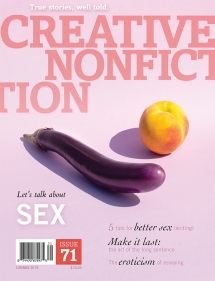
CNF71 CVRIf I had children, they would be mortified. An essay I wrote about sex with my late husband is included in the new issue of Creative Nonfiction Magazine. It’s pretty graphic. I talk about his problems maintaining an erection after he was diagnosed with Alzheimer’s disease and about my problems with menopausal dryness and the need for lubrication. I even talk about offering him a blow job. OMG. Thank God my parents will never read this. I hope my stepchildren never see it.

Not that the general public reads Creative Nonfiction. Most people can’t even define creative nonfiction: true stories told using the techniques of fiction, such as characters, dialogue, setting, plot, etc. Making it into Creative Nonfiction has been a life goal since I earned my master of fine arts degree in creative nonfiction 16 years ago. So career-wise, this is great, but oh my God, do I really want people to know this much about me?

But then you readers here at Childless by Marriage already know so much. If you’ve read my Childless by Marriage book, you already know things I would not want my family to know, things I have never told anyone else.

Editor Lee Gutkind points to my story as an example of things they couldn’t have published even 10 years ago. He’s right. Not in a public journal like CNF. But here at the blog, we’ve always been pretty honest. It’s part of the story.

We are childless by marriage. How does one create a child? Sex. So if we’re not getting pregnant, something involved with sex is preventing it, whether it’s birth control, impotence, infertility, or abortion. In my Creative Nonfiction piece, I talk about stopping coitus to find some lube. When I was younger and with other men, it was about running to the bathroom to insert my diaphragm or grabbing a condom. If we had just kept going, I might be a mother now, but we didn’t. Somebody always stopped the proceedings, said, “We’d better . . .” and we did. Or we switched to an activity that did not include placing penis in vagina.

Now my church, Catholic, says sex is only for making babies. But most Catholics I know use birth control. It’s one of those things we don’t talk about–and probably should.

When you decide to sleep with someone, you immediately need to figure out what you’re doing about birth control, not just to prevent pregnancy but to prevent STDs. If you’re on the pill, you can choose whether or not to mention it, but if you’re using another method, you’ll have to discuss it. You will know whether, at least at that moment, your partner is interested in creating a baby. Which may lead to more long-term choices.

Sex is such a vital part of life, but until recently we didn’t talk about it much, and we certainly didn’t write about it. I’m both embarrassed and proud of my essay. When I wrote it, I thought it was funny. I still think people will get some laughs out of it. But it also shows the realities of middle-aged sex and dementia. Why keep it a secret? Everybody deals with this stuff.

I haven’t read the other pieces in the magazine yet. This is a print publication, not online, and copies haven’t arrived yet. The link will show where you can order a copy.

Some of you have confided that your partners refused to have sex with you. So hurtful! I wonder how many dare to mention their desire for babies while they’re making love. What are those conversations like, when you’re lying together naked and happy? Or are you afraid to mention it for fear of ruining the mood?

I don’t want to turn this into a porn site, and I sure hope I don’t get a lot of filthy responses, but we can be honest here. I’m honestly glad I don’t have children and grandchildren reading about Grandma and Grandpa having sex. Ew, gross.

One of the advantages of being childless, I guess.

I just realized the magazine never asked and I never mentioned whether or not I had children. Interesting.

Thanks for being here.

Can a childless novelist write about moms?

An early reader of my new novel Up Beaver Creek, coming out in June, thanked me for writing about a woman who has no children. My protagonist, who calls herself PD, is unable to conceive with her husband. They are starting to look into adoption when he is diagnosed with cancer. He dies, and she moves west to the Oregon coast to start a new life as a musician. Lots of things happen along the way to make it interesting, but none of it is about having babies.

PD meets a colorful group of new friends, including a lesbian couple, a bipolar man who has created a garden out of glass and cast-offs, a young soprano who becomes her best friend, and a music store owner who likes to jam.

Most of the characters don’t have children. Even for those who do, the children do not play a big role in this book. Did I do this on purpose? No, I think it’s the just the way I see life. I do not live in the circle of mothers and grandmothers. I occupy the circle of women who live alone. Occasionally those circles cross. Is this a handicap? Can I write about something I have never experienced? I worry about that sometimes.

Ages ago, I wrote a never-to-be-published novel titled Alice in Babyland. I was still fertile back then. Our main character, Alice, is surrounded by people having babies. It’s driving her nuts. It’s not a very good novel, but it’s how I was feeling at the time.

My published novel Azorean Dreams ends with Chelsea and Simão getting married and preparing to “start a family.” You just know they’re going to have a flock of Portuguese kids. But readers will have to imagine that part.

I have been rewriting another novel I’m calling Rum and Coke. The characters do have children. One of them is pregnant. I’m struggling to get it right, to make the children real people and the relationships and challenges among parents, grandparents and kids authentic. I will never know how it feels from the inside, only from the outside. There are a lot of other things I have never experienced. I count on research, observation, and imagination to write about them. Can I do that with motherhood? I sure hope so.

Think about the books you have read or, if you don’t read books, the movies and TV shows you watch. How often are people portrayed as permanently childless by choice or by chance? We see a lot of single parents and a lot of couples with kids, but how many do we see without children?

The book I just finished reading yesterday, Hot Season by Susan DeFreitas, has no children, but the characters are mostly college students under age 25. Presumably, they’ll think about that later. In the book before that, Jojo Moyes’ Me Before You, nobody was talking about babies, either, but Louisa was very young, and Will was a quadriplegic contemplating suicide. The focus was on making him want to stay alive. I have ordered the sequel, After You. We’ll see if babies show up there. (If you have read it, don’t tell me.)

Is the tide turning? Are we getting more books where the characters are not moms and dads? Is fiction beginning to reflect the fact that one out of five women in the U.S. and other developed nations is not having children and the number seems to be growing?

I’m pleased to offer PD as a strong, childless woman. I hope that not being a mother doesn’t mean I can’t write about mothers or anyone else.

Your thoughts?

Can a childless actress portray a mother?

British Actress Anne Reid was quoted recently in the Telegraph as saying that childless actresses cannot portray mothers because they don’t really know what it’s like. (http://www.telegraph.co.uk/culture/film/film-news/8279466/Actresses-without-children-cant-play-mothers.html)What do you think? Can we not use what we have seen and experienced in our lives to imagine what it’s like to be a mom? Should we flip it and say that women who have children cannot play characters who are childless–or childfree?

I wonder about this as a writer, too. Can I really write accurately about what it’s like to give birth and to be a parent when I have not experienced these things for myself? But writers write about a lot of things that they haven’t personally experienced, right?

What do you think?