Easter goodies for childless readers

Today, still overwhelmed and under-inspired, I’m offering you an Easter basket full of links and thoughts.
“The A Word: Why We Didn’t Adopt” by Loribeth at The Road Less Travelled. It’s something people don’t talk much about. I haven’t really addressed it here, but this long post will fill that gap.
Loribeth at The Road Less Traveled talks about the new book Selfish, Shallow, and Self-Absorbed: Sixteen Writers on the Decision Not to Have Kids. I have not read it yet, but I’m planning to. Apparently, it leans hard to the childfree-by-choice side, but maybe we can identify with some of it, and there’s a lot of wisdom in Loribeth’s review.
“When Men Want Kids and Women Aren’t So Sure” Usually it seems to be the other way around. This New York Magazine piece looks at young women who aren’t so ready to join the mom club. Check out the comments, too, almost 200 of them at this point. It’s just a hard thing to figure out, isn’t it?
I hope you enjoy these links and follow them wherever they take you.

Question:

If you were advising a young person in your life who was considering a permanent relationship with someone who doesn’t want to have children, what would you tell them? Forget about your own situation for a minute. What would you tell this nephew, daughter, or friend whom you love?

Happy Easter to one and all. Don’t forget that it’s about more than a bunny who lays chocolate eggs.
Childless readers, I need some inspiration


Dear readers,
I know I’m late with this week’s post, but I’m coming up empty. Usually by the time I set fingers to keys on Wednesday morning, something has begun to form in my mind, but right now, Thursday evening, I’ve got nothing. I can tell you a few things:
1) It’s spring break here on the central Oregon coast, and the place is swarming with tourists, half of whom seem to be either babies, young children, or pregnant women. I mean, everywhere I look. It’s bumming me out. Most of the time, I don’t see that many kids or pregnant people because the population is so heavily slanted toward the over-60 crowd, but wow, they’re all over my world this week. Kids, parents, grandmas and grandpas in my face every time I leave the house.
2) I seem to be doing a lot of caregiving lately. No, my dad is fine, but a good friend had heart surgery last week, so I’m back to sitting beside a hospital bed. Also, my elderly neighbor needed someone to sit with her husband, who is suffering some serious mental and physical problems after his heart surgery turned out badly, so I hung out at their house. And now, my dear dog has Kennel Cough/aka Bordatella. Every time she starts coughing, my heart stops. The drugs seem to be working, but all of my mom cells are engaged in taking care of her. And yes, she did get vaccinated.
3) The childless news is full of the usual stuff: somebody’s leaving their fortune to their pet monkey, the Pope says childless couples are selfish and sad, pollsters are predicting a lot more seniors living alone in the future because fewer people are having children. The childfree crowd is still claiming you don’t need children to be happy. And I keep getting comments from people who claim a spellcaster has solved all their problems and now they’re happily married with children.
Help me out, you guys, send me some ideas. I might even accept a guest post or two. Let’s keep the conversation going.

Monkey children, fantasy Sundays, mean questions—It’s a crazy world


Dear friends,
Today, I’m sharing links to a series of articles that I think you’ll find entertaining.
Okay, these Sundays are both fantasies. I may not have kids, but I have never had a Sunday like the one described, and kids or not, nobody does that much laundry. Read it for fun.
If you’re not Christian, skip the early paragraphs and go right to the list. I’m guessing you can identify with these.
Hang in there, my friends. And somebody send me some comments that are not spam.

Ever feel like you’re from another country, the land of no babies?

At the local post office, one of the workers brings her baby every day. I have seen her grow from newborn to just starting to walk and talk. She’s a cute, smiley child. I watch her and her mom with curiosity, but I don’t know how to interact with them. Yesterday as I was collecting my mail, I watched a white-haired man having so much fun talking nonsense to the baby that he couldn’t seem to tear himself away. Clearly he’s had years of practice talking to babies, his own, his grandchildren, perhaps nieces and nephews. I have never been around babies, and I don’t have the vocabulary for it.
At the library, I encounter a group blocking the stairs, two young mothers and three little kids, so busy talking they don’t notice me trying to get to the ground floor to sit alone and write for a while. I edge around them. The children’s room, occupied by more moms and babies, sits at the bottom of the stairs. I feel as if I am not allowed to step into that room.
A friend is hosting a series of parenting classes. She keeps sending emails asking us to help, but I am no more qualified to teach parenting than I would be to give surfing lessons or teach Mandarin.
Many of my friends have children and grandchildren. When we work on common interests, such as music or writing, we connect. But then they suddenly start talking Mommy, and our connection fades away. It’s a lot like when I walk into the chapel during the Spanish choir rehearsal. I know some Spanish, but they talk too fast and use words I just don’t understand. They look at me like I don’t belong in their world, and no matter how many Spanish classes I take, I never will.
I often feel that I’m from a country that has no children, only dogs and cats. One is not better than the other, just different. Does any of this sound familiar to you? As childless people, are there situations where you feel like you come from another country? Please share. I’m pretty sure I’m not the only one.

Remembering “Gramma” Rachel

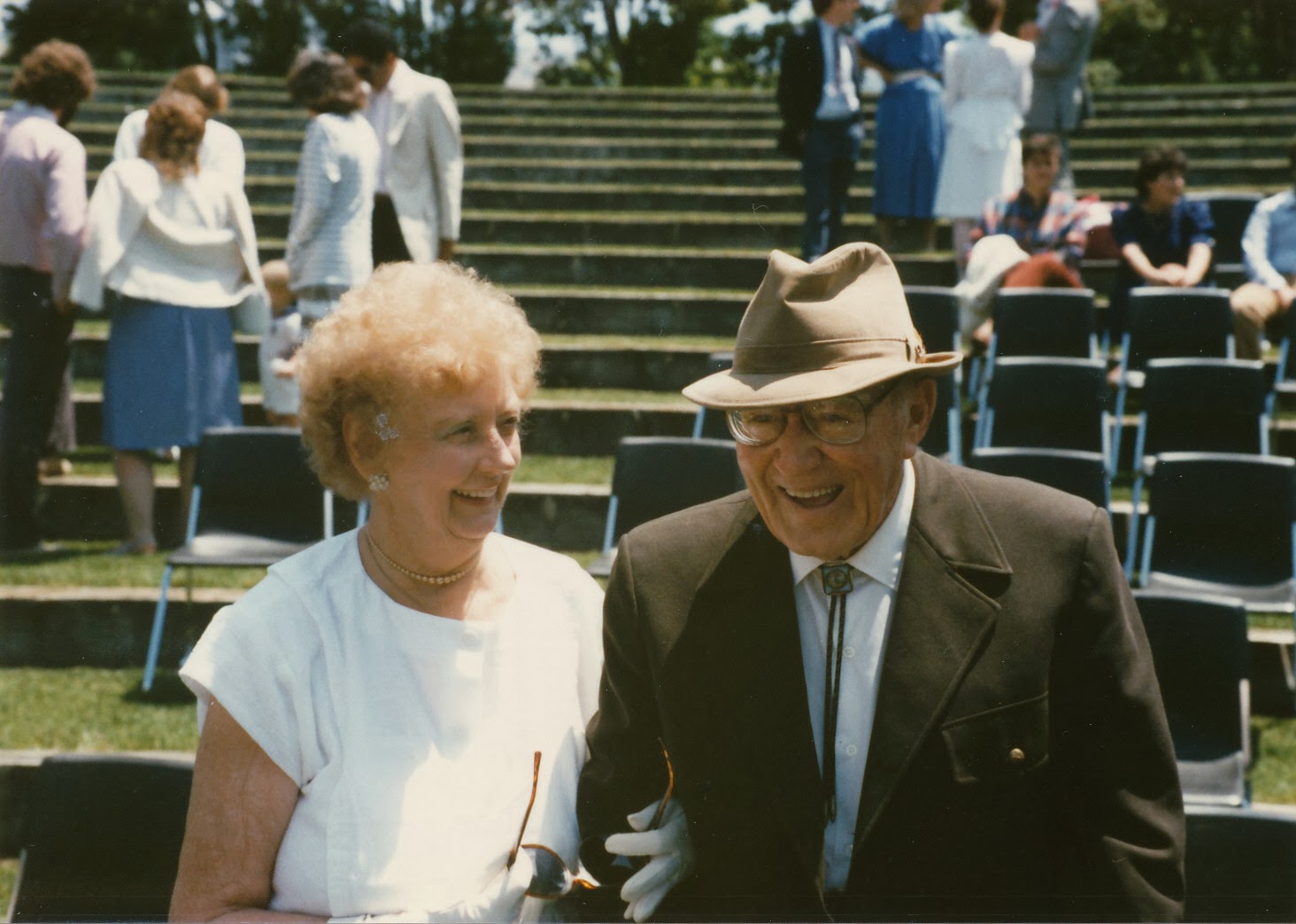
Rachel and Clarence Fagalde at my wedding in 1985
Today my step-grandmother would have been 109 years old. Mind-boggling. My father’s mother, Clara, died when I was 2, so I don’t really remember her. I remember Grandma Rachel, who married my grandfather a year or two later. She had been married before, but she never had children. I never asked her why.
Grandma Rachel was the one who encouraged me as a fledgling writer. She gave me countless books, all inscribed to “My dear little Susie” from “Gramma” Rachel. She always put the “Gramma” in quotes, as if she felt she didn’t deserve the title. But she did. She was as much a grandmother as any woman ever was. She showered me, my brother, and my five cousins with love, support and gifts until the day she died. Longer, in fact. A cassette tape she sent me arrived a few days after cancer took her away in 1991.
Now I don’t think Grandma Rachel was much good with babies. I can’t picture her changing a diaper. She was a terrible cook, her housekeeping was iffy, and the grownups tended to roll their eyes at the way she talked. But we kids didn’t care about any of that. She cared about us. She wanted to know about our friends, our schoolwork, and the boys we had crushes on. She wanted to see what we had made and was always eager to read what I had written. She was never too busy doing grownup things to spend time with us.
Perhaps not having children freed her to do these things, or maybe that’s just how she was. I don’t know if she ever grieved her lack of children, or if she quietly celebrated her childfree life. Perhaps with two stepsons, seven grandchildren, and a nephew and three nieces whom she adored, she didn’t have time to think about it.
Perhaps she had enough to deal with in marrying Clarence Fagalde. For most of his life, he worked as foreman of the Dorrance ranch in San Jose, California. When they married, Rachel moved to the ranch, where life revolved around the prune and cherry crops. The work never ended. When Clarence retired, they moved to a small house at Seacliff Beach, a little ways south of Santa Cruz. Grandpa fished and puttered around the yard, tending his “Garden of Eden,” while Rachel painted, read, and wrote poetry and copious letters to everyone, including me. I treasure those letters, and I treasure the memories of our many visits.
Not every step-family works as well as Grandma Rachel’s did. We’ve all heard horror stories about kids who hate the new wife, battles with the ex, and husbands who favor the kids over the wife. My own situation was far less amiable. But Rachel made it work, and so can we.
On this, her 109th birthday, let her be a reminder that we can have happy lives even if we never give birth.

Don’t expect to get pregnant in your 40s

Women in their 40s who are still trying to figure out whether to have children are not going to like this post, but they need to know the facts.

A reader sent me a comment today that fit right in with a recent news story I was planning to share. She’s 42 and has a child from a marriage that went sour. Now she’s dating a 28-year-old man she calls her soul mate. At first he said he didn’t want children, but now he does, and she’s stewing over whether or not to have a child for him. Read the whole comment here.
The thing is, she’s not likely to get pregnant at 42, even if she decides she is willing. Check out this article at cnn.com. “The‘Big Lie’ in putting off pregnancy” makes it clear that while today’s 40-year-olds may be as youthful as yesteryear’s 25-year-olds, their eggs are old-school. A lot of the reason more than twice as many women age 40-44 are childless as in 1976 is that they’re delaying parenthood while they build their careers and enjoy the unfettered life. Meanwhile their eggs are going stale. By the time they think about having children, it’s too late.
The article notes that a woman in her 20s has a 20-25 percent chance of conceiving naturally per menstrual cycle. In her early 30s, the chances are 15 percent. After 35, it goes down to 10 percent. After 40, the number falls to 5 percent, and after 45, it’s only 1 per cent. It doesn’t seem fair, but that’s the way it is.
Well, you can just go to the doctor and start fertility treatments, you say. Unfortunately, most of the women who go that route do not successfully conceive. They spend thousands of dollars, experience lots of disappointment and sometimes several miscarriages before they give up. Sure, we hear about celebrities and others having babies in their 40s, but for most of us that’s not going to happen.
Last night, I lay in bed running the numbers. During my first marriage, I was in my 20s, but my husband wasn’t ready for children. When I married Fred, I was 33. I had time, but not much. Scary.
A lot of readers who comment here are in their late 30s or early 40s, still trying to work out the baby thing with their mates. I hate to put more pressure on you, but there’s no time to waste. Men can wait, but women can’t. In your discussions, show them the numbers. Maybe they’ll get the point.

Those Childless Moments Hit Hard

The other day I was walking the dog down Cedar Street east of where I live when a car pulled up and parked at a house just ahead of me. I watched as a gray-haired couple got out. They turned and looked toward the corner. The school bus had just let out its passengers, and now three children were running toward the older folks shouting, “Grandma! Grandpa!” I was barely past them before I started to cry.
Part of my emotion came from what’s been happening with my father. If you’ve been reading this blog, you know that I hurried to California last month when my dad became very ill with congestive heart failure and a blocked aortic valve. When I first got there, it looked like he could die any minute. He was so pale and so thin. Every time he dozed off, I looked to make sure he was still breathing. He rallied somewhat with the help of medication but faces heart surgery early next month.
While I was in California, we looked through piles of family photos of my grandparents and his grandparents. Dad showed me where things are in the house “in case I conk out.” We talked a lot about death, not an easy subject, but he needed to talk about it, and I needed to listen.
For my brother’s side of the family, Dad is “Grandpa.” But I never made him a grandfather. All I have to offer is myself and a dog. And I will never be a grandmother. Yes, my stepdaughter’s children called me “Grandma” for a while, but I haven’t spoken to either of them in years. They have their own grandmother and great-grandmother, but I don’t have any kids or grandkids I can claim as my own. My grandparents are all gone. So is my mother. In a few days, months or years, my father will be gone, too. So I cried as I walked the dog through our muddy streets on a cold November afternoon. It was just one of those moments.
Many of my readers here are younger than I am, wondering how it will be years from now if they never have children. I tell them it will get easier. It’s true. Once you get past menopause, once the time of worrying about whether or not you will become parents is over, you accept for the most part that your life is about other things than raising children. You get a lot more comfortable with the idea. But there will be moments like mine on Cedar Street when the reality hits you like a baseball bat and the tears come. As my dad is fond of saying, “That’s just the way it is.”
As always, I thank you for being here, and I welcome your comments.

Would you marry someone who is infertile?

We often talk here about couples in which one partner is not willing to have children. Sometimes they discuss it before they get married. Other times it comes as a rude surprise to the partner who wants kids. But what about situations where one partner, for whatever reason, physically cannot make babies? What if you knew that going in? Would you sacrifice children for love?
I’ve been doing a little reading about marriages in which a partner is infertile. Many of the listings that come up are religious discussions. As you might expect, the Catholics dominate. The main thought is that for a marriage to be valid, the couple must have a sexual union. That means if a partner is impotent, i.e., can’t have sex, and they know it before the wedding, they can’t have a valid marriage. If it happens later, that’s okay. But if the couple is infertile, that does not invalidate the marriage. If their sexual union does not result in children, they’re still married.
Some folks are using the same arguments in their debate about gay marriage. After all, a same-sex couple cannot  procreate without outside help. But they do have a sexual union. I’m not going to get into whether or not gay marriage is a good thing. I think if people love each other, they should be allowed to be together. Period. But it does underscore the question I am asking today: Would you marry someone who is unable to provide the necessary sperm or egg to conceive a child? Or is that a deal breaker?
In my case, I knew Fred had had a vasectomy, and I knew it had taken 16 years for him and his first wife to get pregnant. But in my usual unrealistic way, I figured we could overcome all that and pop out some babies while I was still in my fertile 30s. What if I had known that there was absolutely no chance? What if instead of saying he didn’t want more children, he’d said, “I can’t.” Would I have married him? I honestly don’t know. I think I would have. I really loved him and didn’t have other prospects. But I’d have been forced to consciously choose a life without the children I always thought I’d have. (Yes, we could have had the adoption talk and I would have learned that no, he didn’t want to do that, so the result would have been the same, but that’s a whole other discussion.)
What if I were the one with the fertility problem? Would I expect a man to give up children for me? Would I be constantly afraid that no man would have me if I couldn’t give him sons and daughters? How and when would I tell the guys I dated? Would I feel guilty about depriving them of kids?
When couples disagree, that’s hard, but infertility is a whole other thing, full of sadness. It’s not a rare thing either. The U.S.Centers for Disease Control and Prevention web site lists statistics for infertility. The percentage of women ages 15-44 with “impaired fecundity” is 10.9 percent or 6.7 million. Stop and think about that. One in 10. On the male side in the same age group, 13.9 percent were surgically sterile (usually vasectomy), 4.2 percent sterile for other reasons and another 5.2 percent considered subfertile, meaning conception was possible but not likely. That’s a lot of guys, nearly a quarter of them.
So how do you feel about that? Would you marry someone you knew was infertile? I would love to hear what you think about this.

Why are we watching ‘The Bachelorette?’

Has anybody else been glued to the TV watching “The Bachelorette?” on Monday nights? I have been completely hooked. I even turned off the phones and the computer for last night’s finale. I know, this does not sound like the intellectual fare that someone of my age and education should be watching, but dang it, I can’t help myself. We’ve got beautiful people wearing beautiful clothes in beautiful places doing beautiful things. Even their meals are beautiful–although they rarely seem to actually eat. It’s a Cinderella story in which Cinderella aka Desiree does not lose her glass slipper but she does get the handsome prince. And he never says, “Oh by the way, I don’t want to have children.” The men always say they want kids, and some who already have children insist that they want more. They want two, three, five, eight, a dozen.

Last night, as Chris proposed to Des, he included children in his proposal. “Do you want to have kids with me?” I’m sitting on my couch in my nightgown screaming “Yes!” He says all the right things, plus he’s handsome and has a good job. Where was this guy when I was dating? Husband number one didn’t even bother with a real proposal. Number two had all the right qualities except that he didn’t want to have kids with me.

I know, The Bachelorette is a fairy tale. I know that the couples rarely stay together long enough to actually get married. And as far as I know, only one Bachelor/Bachelorette couple has had children together. But don’t spoil my dreams with the reality of reality TV. I want to believe they will live happily ever after in a house full of beautiful children and beautiful grandchildren.

In a Huffington Post article titled “What Could You Have Done With All The Hours You Spent Watching ‘The Bachelorette’?Jessica Goodman tallied up how many hours fans have spent watching “The Bachelorette” over the years: 6.54 days or 157 hours. She offers suggestions for other ways we might have used that time. Not one of those suggestions involves kids, but they might be fun. Check it out.

Is watching this show a waste of time? Or is it okay to seek comfort in fantasy when our own lives haven’t turned out quite the way we planned? And now what will we do on Monday nights?

I welcome your thoughts.

Childless Can Enjoy Other People’s Kids

Last week I expressed my discomfort around other people’s babies. Lots of you agreed with me, but not every person without children feels that way. Many are fabulous aunts, godmothers and friends to other people’s kids. Others are teachers, caregivers, music directors, or coaches who interact with children all the time. 

Yes, some of us are more at home around puppies than human babies, but a great article posted at Christianity Today called “I’m Childless, Not Child-Incompetent” tells the other side of the story. Please don’t let the Christian setting scare you away if you’re not religious. It’s really about the divide between parents and non-parents and the misconception that all childless people are clueless about babies and don’t want to be around them. Author Gina Dalfonzo talks about her relationship with her godchildren and about how people who don’t have their own children have special gifts to offer those who do.

I know. Some of us have so little experience with children that we just don’t know how to act around them. Others feel so bad about their inability to become parents that they can’t look at a baby without bursting into tears. But many childless people jump in and help with kids, and I suspect doing so helps lessen their own feelings of loss or grief. Hey, how else can you get to play with Barbie, sing silly songs or watch the latest Smurf movie?

Read the article and let me know what you think.