Realistic childless role models, real or fictional, are hard to find

The last novel I read, titled The Way It Should Be, was enjoyable but typical of the prenatal slant we usually get. Early on, newlyweds Zara and Chad discover Zara carries the gene for a fatal disease she could pass on to their children. She’s thinking they should not get pregnant. But he really wants a family. Will he leave her if she can’t give him sons and daughters? Before they can think twice about it, the children of a troubled family member fall into their laps. They’re adorable, and eventually they adopt them. Easy-peasy. Not realistic. I like a happy ending, but it would have been a more meaningful book for me if Chad and Zara had been forced to deal with their situation as potential non-parents and how that would change their lives.

Have you read any good books with childless characters lately? Sometimes it seems that every adult character we encounter in books and other media has children. But that’s not how it is in real life. The NoMo (non-mother) book club was formed to highlight books for those of us who are not parents. They have compiled quite a list. Visit their site at https://www.instagram.com/thenomobookclub.

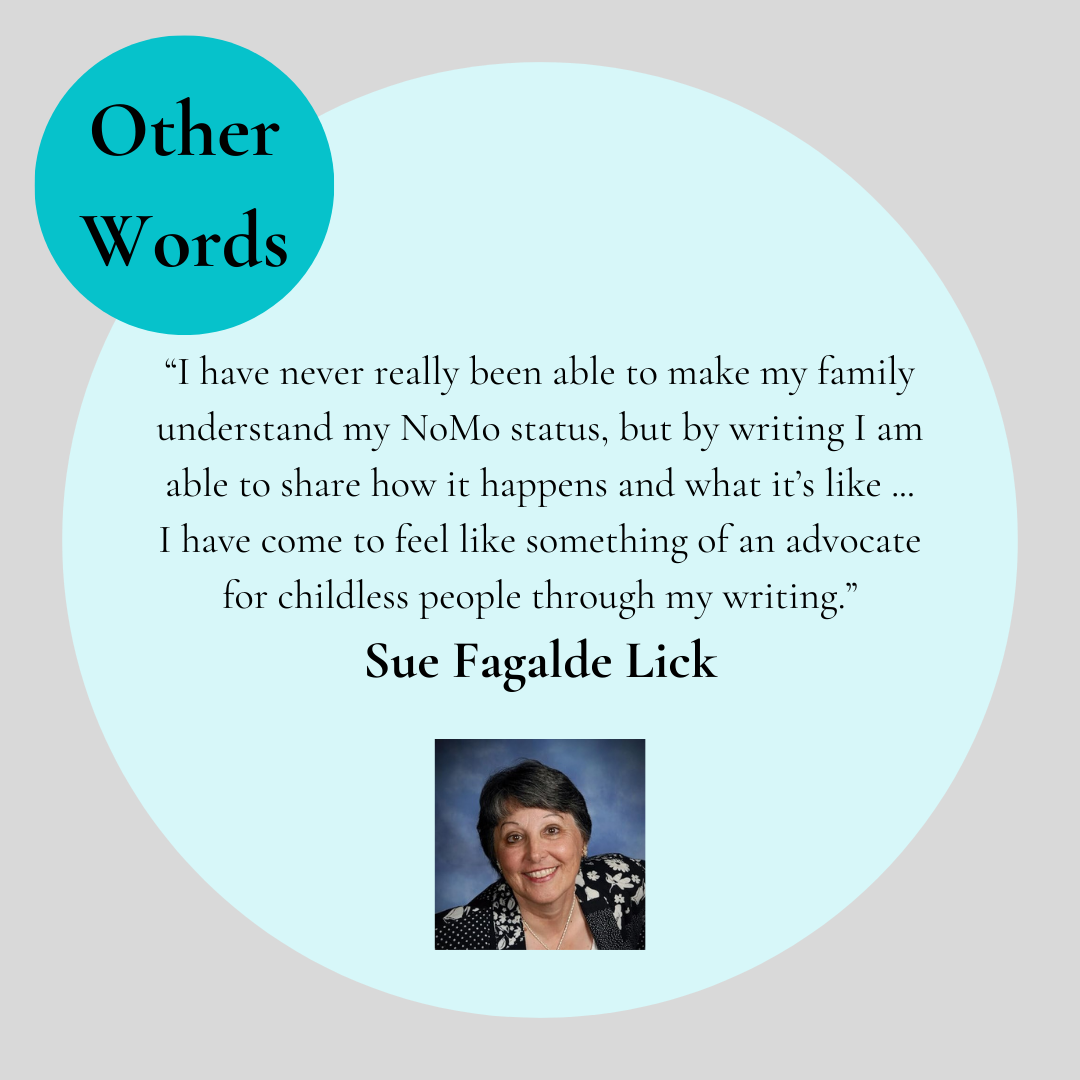
Book club member Rosalyn Scott has started a new feature there called “Other Words,” where she interviews childless authors. The site goes live this Saturday, Jan. 13. and includes an interview with me about my books and writing. The image shown here includes a quote from that interview. I look forward to reading all the others. I know a few of the authors, but most are new to me. Give it a read at https://thenomobookclub.wixsite.com/otherwords. Visit the nomocrones instagram site for some good reading ideas. If you have a favorite book that fits the “NoMo” category, let the book club know at thenomobookclub@gmail.com.

Speaking of books, have I mentioned that I have four coming out this year? One of them is the next in my series about PD (no kids!) and her friends at Beaver Creek, Oregon. Two more are poetry books, and the fourth is No Way Out of This, a memoir about going through Alzheimer’s Disease with my late husband. It’s nuts. But could I say no to any of my dream publishers who wanted to publish my work? Heck no. It will be an interesting year of proofing covers and pages, publicity and marketing, giving talks, and trying to find time to manage the rest of my life. If I had children, they would be badly neglected.

It’s like giving birth to quadruplets. At any particular time, one is crying, one needs a diaper change, one has a fever, and the other has just spit up all over me. I’m raising books instead of people. How about you? What are you raising this year?

On Dec. 20, the childless elderwomen held their fireside chat about childless role models. What most of us decided was that although we could name some famous people without children, we didn’t have many real-life role models to follow. When we were of childbearing age, no one talked about why some people didn’t have children. Rumors were tossed around, but no one sat down and had an honest discussion about it. Now, we have become role models for each other. Perhaps you younger readers can be role models for us. I think the lesson to be learned from this is to talk about it. If you know someone who hasn’t had children, ask them in a quiet, private moment if they mind chatting about it. You could tell them about your own situation and say you’re seeking advice about what it’s like. We have to stop the silence.

Meanwhile, here’s a link to the video. https://jodyday.substack.com/?r=ejjy9&utm_campaign=pub&utm_medium=web It’s a little over an hour long.

I welcome your comments, and I hope your new year is starting out well.

Sue
Processing…
Success! You're on the list.

Are You Giving Up or Have You Had Enough?

What’s the difference between giving up and deciding you’ve had enough? Sheri Johnson addressed that question at her “Awakening Worth” podcast recently. Johnson, a Canadian mindfulness coach who struggled with infertility, offers an extensive program for people trying to figure out life without children. Many of her points in this podcast can be applied to our childless-by-marriage situation.

The main difference between giving up and deciding you’ve had enough comes down to fear, she says. You give up out of fear, fear of regret for not doing more, fear that if you did have a baby you would regret it, fear of judgment from other people—why did she stay with him? Why didn’t he stick with her?

We may give up out of fear that we’ll end up alone. What if you leave him and never find anyone else? What if you try to have a baby on your own and it doesn’t work? What if the adoption falls through? What if you push too hard and he/she leaves you? What will people say if you never have children or grandchildren?

“Giving up is quitting because of fear. It’s quitting before you can fail.” It’s an act of self-preservation, Johnson says.

Deciding you’ve “had enough” is the other side of the coin. It’s an act of self-care. You have reached your end point. In her case, it was stopping fertility treatments. For someone else, it might be deciding that you need to end your relationship or that you will choose childlessness because your relationship is too precious to give up. It takes courage, tons of courage to say, “This is what I need to do for myself,” no matter what anyone else thinks.

What do you think? Are you giving up or deciding you’ve had enough? Is the question even valid in your situation? Are you not ready to make a permanent decision either way? Let’s talk about it.

You can read Johnson’s views on the subject at her website, https://sherijohnson.ca/54/. You can find more podcasts and writings about childlessness and “worth,” along with various services and things to buy. She offers a free “worthiness” quiz you can take. You can also find her on Instagram at awakening.worth.

****

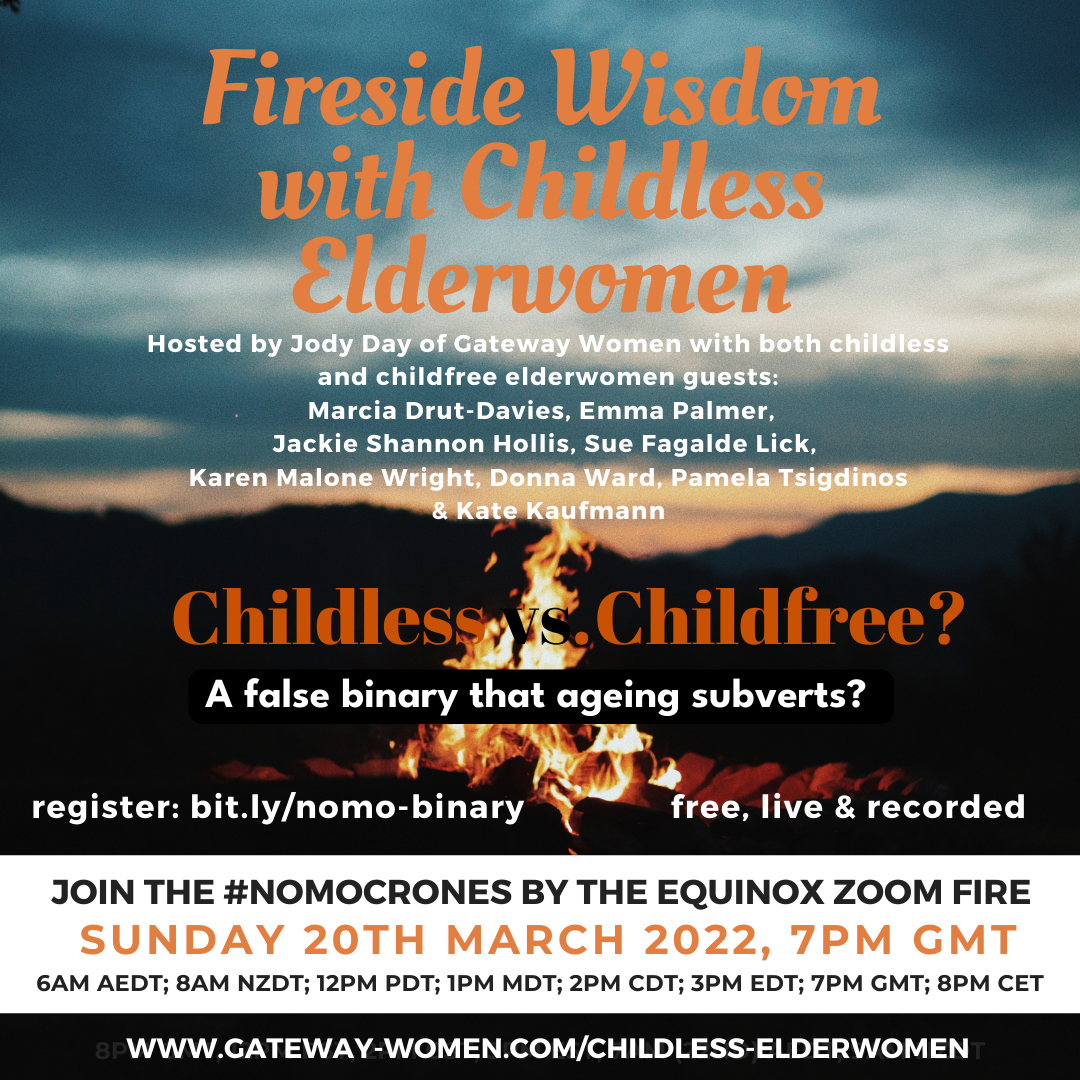
The “Nomo Crones” are meeting again. This international group of childless elderwomen led by Gateway Women’s Jody Day will meet via Zoom on Sunday to talk about being childless vs. childfree. It’s a subject we discussed here in January, but there’s so much more to say. For those of us who are childless by marriage, I think the line between choice and non-choice is always a little hazy. If we had chosen another partner, we might not be childless. Register at bit.ly/nomo-binary, and tune in at whatever time fits your zone. It’s noon Oregon time, 8 p.m. in the UK. I would love to “see” you there. You will not be on camera, so don’t worry about blowing your anonymity, if that’s a concern. You will be able to talk to us in the “chat.” Join us, and let us know what you think. If you’re not a “crone” yet, even better. We need to hear from all ages.

Processing…
Success! You're on the list.

Nomo Book Club offers ‘safe’ books for childless readers

Tired of books where everyone seems to have children? Like the book I just read in which one of the female leads has two children, 8 and 14, and the other has a one-year-old and a baby on the way?

So was Lisa Ann Kissane, one of the speakers at the recent Childless Collective Summit. Childless herself, she was weary of childless characters having miracle babies, successful fertility treatments, or being given babies to raise. Bam, you’re a mother, problem solved. So she founded the “Nomo Book Club,” nomo being short for “not mother.”

Lisa Ann reads constantly, looking for books that won’t be upsetting to women who don’t have children for whatever reason. She rates them with a “trigger warning level” from red–don’t read this–to orange–proceed with caution–to green–no worries here. The green ones are hard to find. Male heroes are often childless, but the heroines not so much.

Certain genres, like romance, seem to require that the women end up married with children or at least the promise that that’s coming. But we all know that happy ending doesn’t always happen in real life. Lisa Ann looks for stories that represent how it really is. She warns there is just as much of a danger of creating stereotypes of childless women as there is of women who have children. The hard-hearted career woman, for example.

When I wrote my novel Up Beaver Creek, I wasn’t really thinking about it as representing childlessness, but I guess it reflects my own reality. The heroine, P.D., was unable to have children, and none of the main characters are raising children. A couple of twin boys make a cameo appearance, but generally this is a childfree book. Is P.D. going to wind up with children? No. She has moved on.

As for my previous novel Azorean Dreams, I’m pretty sure the protagonist, Chelsea, will soon be a mother. I wrote it more than 20 years ago and went with the cliché.

Lots of book titles were tossed around during the Summit discussion with Lisa Ann. Among her recent favorites are Midnight Library by Matt Haig, Confessions of a Forty-Something F##k Up by Alexandra Potter, Sourdough by Robin Sloan, and Convenience Store Woman by Sayaka Murata. See her latest recommendations at Kissane’s website, https://lisaannkissane.tumblr.com.

The featured book for March was Eudora Honeysett is Quite Well, Thank You by Annie Lyons. In April, she offers a book of poems, The Princess Saves Herself in This One by Amanda Lovelace. Don’t you love the title?

If you like to read, I highly recommend joining the Nomo Book Club. Have you read some books that you found encouraging for childless readers? Are there others that made you feel bad because they were all about babies? Please share.

Processing…
Success! You're on the list.

Read about the "Silent Sorority" of barren women

Have you read Silent Sorority? I can’t put it down. In this memoir, author Pamela Mahoney Tsigninos tells the story of her struggle to get pregnant, trying all the techniques that modern science has to offer, before realizing she will have to accept her childless state as permanent. Yes, she is struggling with infertility while many of us are fertile but don’t have a partner who wants to make babies with us, but many of the challenges she faces, especially in the second half of the book, are the same. Indeed, her title echoes what most of us know: people don’t talk about this stuff much.

Tsigdinos writes with such a free-flowing easy style that I have already gotten halfway through the book in half a day. You can read about her and her book at www.silentsorority.com.

While I was blog-hopping yesterday, I came across Laura Carroll’s blog, called La Vie Childfree. Carroll is the author of Families of Two, which tells the stories of 15 married couples who have decided not to have children. She has published a fascinating post this week on the increasing number of Gen Xers who are not having children.

I also found http://gateway-women.com, a UK blog by psychotherapist Jody Day for the one in five women who don’t have kids. She calls us “nomos,” short for “not-mother.” You’ll find some good reading here, too.

Cheers.