Is the Declining Birth Rate a Real Problem?

Simone and Malcolm Collins have six kids and are hoping for ten, each produced by in vitro fertilization and delivered by C-section, because they believe the U.S. is heading for a crisis if people don’t start having more kids. 

A Washington Post article on the couple reports that the average fertility rate in the United States has not been above the 2.1 children per couple replacement rate since 2007, according to World Bank data. “Currently, no country in the developed world, barring Israel, has a fertility rate above replacement level, and, based on U.N. projections, by the end of the century, almost every country will have a shrinking population.”

They are not the only ones concerned that in the not-too-distant future, we will have empty schools and overflowing nursing homes with not enough people to do the work needed to run the world. The Collinses join a growing group of people, mostly firmly on the red side of politics, who decry the tendency to have fewer children as selfish and wrong. Today’s young people just want sex with no responsibilities, they cry. They play around until they’re too old to have babies. 

This, of course, ignores the many reasons people may not have children, including infertility, illness, lack of a willing or able partner, choice, and a wide range of situations that fall somewhere in-between.

Those favoring more baby-making include Vice President J.D. Vance, famous for his comments about childless cat ladies. “I want more babies in the United States of America,” Vance said at the March for Life on Jan. 24, in his first public speech as vice president. The Collinses are hoping to become part of a national “pronatalist task force.”

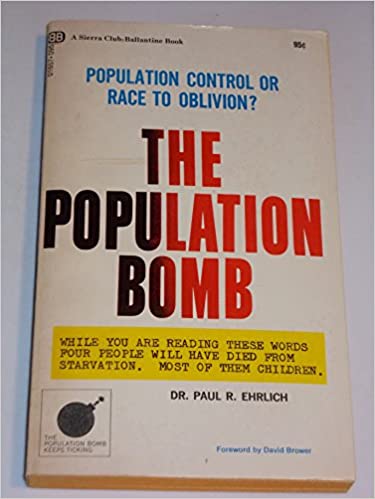
It’s a big change from the 20th century cry that our growing population would lead to disaster. Having too many people would destroy the land, and overcrowding would make life unlivable. Paul Erlich’s The Population Bomb was required reading when I was in school. Now, people are reading Empty Planet, about how our shrinking population is going to lead to big trouble.

Population growth has always been a cyclical thing.

One of my great grandmothers had 13 children. Another had seven. It was what people did back when most women saw few life choices beyond motherhood or the convent. Birth control and abortion were not easily accessible. If you had sex, you had children. 

Before the advances of modern medicine with its vaccines and antibiotics, many babies didn’t survive to adulthood, so it made sense to have more. I don’t know if any of my ancestors’ children died young. Everyone who knew them is gone now. But it seems likely.

My grandmothers each had two, plus one miscarriage each. Don’t ask me how they limited it. Who thinks about grandparents having sex?

My own parents married right after World War II, the height of the baby boom. With the war over, the world looked bright and shiny, the men had VA loans and GI bill money, and jobs were plentiful. It only took one income to buy a house and raise a family. So, they did. Two kids, sometimes three. My parents used condoms; my brother found them when he was snooping around. 

Values were different in those days. While married couples were expected to procreate and the only ones who didn’t were physically unable to, my parents made it clear pregnancy outside of marriage would RUIN YOUR LIFE. Girls who got themselves “in trouble” were shuffled off to a distant aunt or a home for unwed mothers to have their babies and give them up for adoption. Now, nearly half of babies are born to single mothers, and nobody cares. 

You’d think that would lead to more babies, but there are other factors. About the time I lost my virginity, birth control and abortion were becoming legal and obtainable. Women were moving into the workforce, demanding equal opportunities with men. Divorce became more common, sometimes leading to people marrying people who had already had their children and didn’t want anymore. 

It became quite possible for women to survive on their own without marriage and for couples to decide maybe they wouldn’t have kids. 

Fast forward to the grandchildren of the baby boomers. The birth rate has plummeted for many reasons. Young people are so busy finishing their education and building their careers they don’t get around to considering children until it’s too late. It costs so much to purchase a home they don’t know how they can possibly afford to raise families. Marriages may not last, the economy may implode, wars are happening, people are shooting children in the schools, and the climate is going nuts. Plus, no one can afford daycare.

In view of recent events, when so many people working at what seemed to be long-lasting government jobs are suddenly fired without notice, severance pay, or options for future employment, a lot of people are worried. If you’re not even sure you can support yourself, how can you support children? 

All of this leads me to wonder what will happen with today’s young people. How many will never have children because it just seems impossible? Will we see a new baby boom as the Maga wave washes away abortion rights and maybe goes after birth control next, as women and non-traditional couples see their equality fading away?

Or will the trend keep heading downward? Will people without children stop being the exception, the odd ones in the room who don’t have baby pictures to show? 

Is this all a lot of stewing about nothing? People will always have sex. Sex leads to babies, except when the body says no or we use some form of birth control. Contraception might become more expensive or more complicated to get, but it will be there. If you’re in a partnership where one wants to have children and the other doesn’t, changes in laws and availability may lead to more arguments but probably not to more babies. 

Nor will couples go back to the “Leave it to Beaver” lifestyle where the woman tends the home and children while the man earns the money. Nobody can afford it, and most women want their lives to include more than motherhood.

What do you think? Have you seen the attitude toward having children change? In what way? Do concerns about world population affect your decision in any way? What do you think it will be like twenty years from now?

Additional Reading

https://www.cdc.gov/nchs/pressroom/nchs_press_releases/2024/20240525.htm

Simone and Malcolm Collins want to make America procreate again – The Washington Post

Falling birth rates, why it is happening and how governments are trying to reverse the trend – Michigan Journal of Economics

Why birth rates are falling, and why that’s not a bad thing | Popular Science

**************************

The Childless Elderwomen are having another online Fireside Chat on Saturday, March 29 at 1 p.m. PDT. The topic this time: “Eldering in a Time of Collapse.” I have to miss this one, but the rowdy “Nomo Crones” (nomo for Not-Mother) are sure to have some interesting things to say on this topic. Find out more and register at https://gateway-women.com/gateway-elderwomen.

If you enjoy the Childless by Marriage blog, you might want to visit my Substack, “Can I Do It Alone?” at https://suelick.substack.com. Many of the readers there have never had children. 
Processing…
Success! You're on the list.

Dropping Birth Rate has Many Governments Worried

My great-grandmother Louisa Gilroy had 10 siblings. Her husband, my great-grandfather Joe Fagalde, had 12. Joe and Louisa raised three sons. Those sons, Clarence, Louis, and Lloyd, had two, three and no children respectively. My dad, one of Clarence’s two sons, had two children. My brother has one biological and one adopted child. I have non

Lest this start to sound like tiresome “begats” chapter in the Bible, I’ll stop there. What I’m saying is each generation seems to be having fewer children. Experts who study these things are starting to worry. We have this huge bulge of baby boomers who are all moving into their senior years, leaving fewer younger adults not only to care for them but to do the work needed to keep society going. Also fewer people to contribute to programs like Social Security and Medicare in the U.S.

It’s not just here.

Recent news reports have talked about how Japan’s birth rate is the lowest it has been since the 1800s. The population is aging rapidly, with a shrinking number of workers.

The median age is 49, highest in the world. The government has been offering incentives such as more parental leave and childcare allowances, but it’s not having much of an effect. Young couples are just not that interested in procreating. It costs a fortune to raise a child in Japan and young women pursuing their careers are not eager to take on a traditional role raising children.

The same thing is happening in China, where the population is decreasing. The situation was exacerbated by the one-child policy put in place in 1980, where it was illegal to have more than one child. Now that has backfired. Deaths exceed births, and the workforce is getting smaller. The one-child rule ended in 2015, but young people raised in homes with only one child are not jumping to take on the costs and sacrifices of having multiple children.

Many other countries are looking at aging populations and fewer births. Why? We at Childless by Marriage can tick off the reasons:

* Birth control and abortion offering more choices

* Women waiting until their late 30s or early 40s when their fertility is already waning

* Couples struggling to finish their education and build their careers before having children

* The high cost of raising children

* The lack of support such as childcare

* Being attracted by other options in life

* Infertility and other health problems

* Partners who are unable or unwilling to have children

* The rise in divorces and multiple marriages, increasing the chances that childless people will marry partners who have already done the parenting thing and don’t want to do it again

For most people, it’s probably a combination of reasons. Nearly all of us shudder at the thought of the enormous families of a century or two ago, especially when we consider that these are just the ones that survived birth and childhood. It’s relatively safe now, so why not have a couple of kids? But a lot of people are saying “no thanks.”

When I was young, the buzz was all about the horrors of overpopulation. Read 1970’s The Population Bomb by Paul Ehrlich. That book caused a lot of couples to choose the childfree life. Fifty-three years later, we still have too many people. Look at traffic, pollution, starving people in third world countries, and the homeless camping on our American sidewalks. The problem is more who and where than how many.

I’ll be gone by the time the low birth rate is a major problem, but what do you think?

Do population numbers have anything to do with your own childless situation? If your government was pleading for more babies, would you have children for the sake of your country? Or does that seem ridiculous?

I welcome your comments.

Processing…
Success! You're on the list.

Book predicts decreasing birth rate will lead to disaster

What to Expect When No One’s Expecting: America’s Coming Demographic Disaster by Jonathan V. Last, Encounter Books, 2013. 

After years of hearing that we have too many people on this planet and that we have to decrease our population, here comes Jonathan V. Last to tell us that if we don’t start having more children, we’re in trouble. We’ll have a population of old people with no young ones to support them. Other authors tell us the exact opposite. Whom should we believe? This book is a slow read, a scholarly compilation of statistics that show the birth rate going down below replacement level in most first-world countries. Last blames it on many factors of modern life, including the cost of raising children, women going to college and having careers instead of babies, the decline of marriage and religion and the general belief that having children will take all the fun out of life. He details the efforts, mostly unsuccessful, that have been made to encourage people to have more children and makes suggestions for how to encourage more births. Last has a strong conservative bias and occasionally laces this footnote-fest with sarcasm, but there’s a lot of interesting information here, and it certainly provides food for thought. 

There’s no doubt the birth rate has been going down. In some countries, such as Germany and Japan, the population is shrinking at a rapid rate. The question is whether this is a problem. I had this book with me at the doctor’s office a couple days ago. When I showed my doctor the cover, she exclaimed that a smaller population is a good thing, that this world has too many people in it. That’s what most people think. Just visit any large American city at rush hour. Wouldn’t fewer people and more open space be good? Yes, we’d have to work out how to manage things like Social Security with fewer workers contributing to it, but wouldn’t it even out in time? 

And how does this affect our individual decisions on whether or not to have children? Certainly overpopulation is often cited by the childfree crowd as a good reason not to have kids. If we’re to believe Jonathan V. Last, anyone who has more than two children should be rewarded with tax breaks and other incentives. But Laura Carroll maintains in The Baby Matrix, reviewed here in February, that couples should be given tax breaks for NOT having children. 

So what’s the answer? I think if you want to have children, you should have them, and if you don’t want them, don’t have them. The population will sort itself out. 

What do you think?  

Is population control a good reason not to have babies?

The world’s population has reached seven billion and is still growing. In her new book, The Baby Matrix, Laura Carroll insists that if our culture keeps encouraging people to have babies we will destroy the planet. People who care will not have children, or if they must, they will have only one biological child. If that’s not enough, they will adopt additional children. The overriding theme of this book is that our “pronatalist” society’s belief that having children is the right and natural thing to do is wrong, wrong, wrong.

For baby boomers like me, Paul R. Ehrlich’s The Population Bomb, published in 1968, was required high school reading. In it, he predicted that if we didn’t do something about our ever-increasing population, the world would become so overpopulated it would self-destruct. This book became the bible for the Zero Population Growth movement. It started about the same time as birth control and abortion became legal for most people in the U.S., so people really did start having fewer kids. The average family produced two children instead of three, six or a dozen.

Still, Carroll says we need to cut back even more. When I talk to people who are childless by choice, many mention overpopulation as one of the reasons not to have kids. It’s rarely their main reason, but it’s one of them.

All of this makes me uncomfortable. Weren’t our bodies designed to make babies?

I was happy to find some articles that report the population has started decreasing, that maybe we’re not headed for disaster. This one from Slate, “About That Overpopulation Problem,” explains that some countries, such as Germany, have already lowered the birthrate so much that the overall population is going down.

With couples waiting until they’re older to have kids, with birth control being available to most people, and more and more choosing not to have children at all, it would seem likely that our population would stop growing. If not, I suppose the natural methods of population control that work with non-humans–predators, natural disasters, lack of food–would eventually balance out the numbers.

What do you think? Do you believe we should limit births to keep the population down? Has anyone in your life suggested this as a good reason not to have kids?