Dogs don’t care why you’re crying

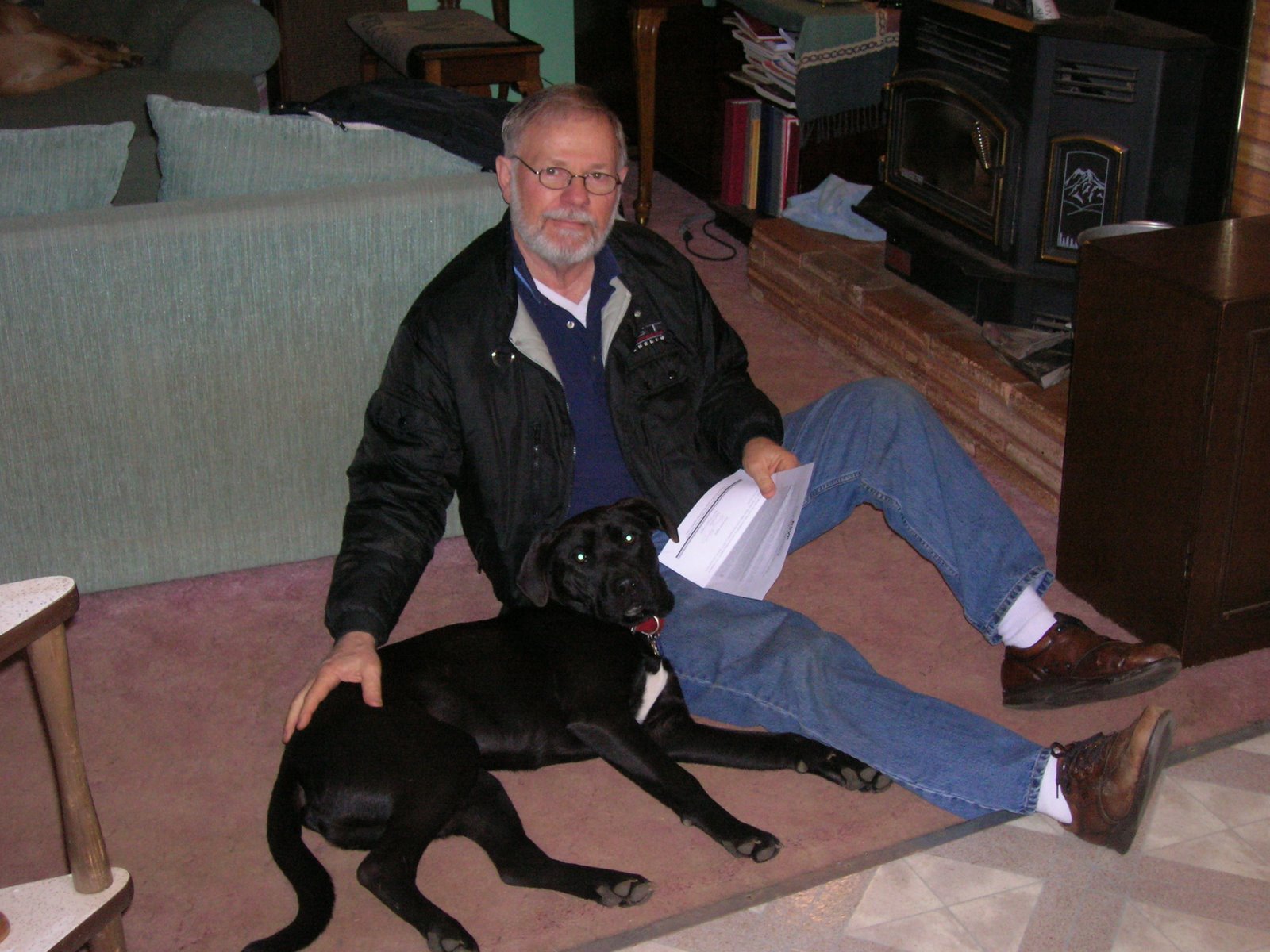
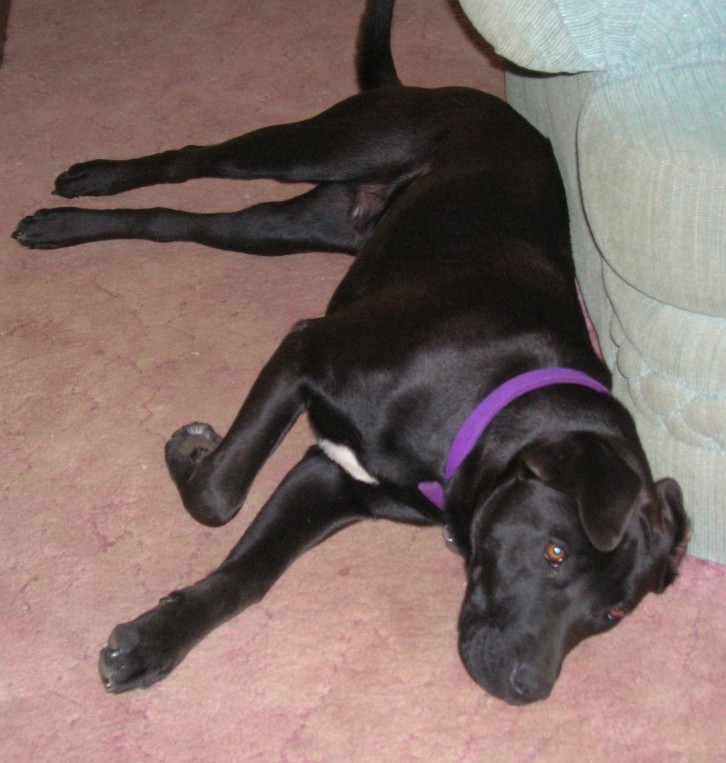
I’m having a depressed day. It took an hour to pry myself out of bed, seeing little reason to do so. But for the dogs, I might never get up, and now I’m spending the day with these beautiful creatures whose only concerns are eating, sleeping, playing and peeing. My husband’s condition is worse every day. I try to wall off my emotions, but it doesn’t always work. Earlier I was sitting at my desk, crying. Human children would want to know why I was crying and demand that I fix them breakfast, but Annie just let me hold her. She and Chico both licked my face, and now they welcome me to their pack, no questions asked, no “what’s the matter”, no “snap out of it”, no “I need . . .” You’re sad; I’m here. That’s it. You rarely get that from a child. Plus you have to suck it up so you don’t worry them.

Get rid of the dogs? I can’t. A lot of trouble? Oh yes. Expense? Wow. But they’re what I’ve got now, and I’m glad to be in their pack. I took them from their mother; they’re my responsibility. They’re not like an old computer. They’re living beings, looking at me with those big brown eyes, plopping themselves into my lap, welcoming me to their yard. As long as we all eat, sleep, potty and stay together, everything’s cool.

Get rid of the dogs?


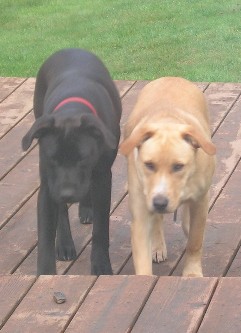
I’m having an $1,800 fence built for my dogs because they keep jumping over the existing four-foot fence. Don’t anybody tell my father–who believes computers are the work of the devil. He thinks I should get rid of the pups. My life is too complicated to deal with them now, he says. But these are my babies. I adopted them when they were 8 and 9 pounds. Now, at one year plus two weeks, they’re about 65 and 70 pounds, but they’re still my puppies, and they’re the only babies I’ll ever have. I can’t just give them away. They’re family.

Yes, they interrupt my work, my meals, my favorite TV shows. They have ruined the carpet and they’re always chewing up something, but I’m proud of how beautiful they are and how much they have learned. When they smother me with kisses or fall asleep leaning against me, my heart melts. I have made a commitment to them, to love them and care for them for life. When they go, I’ll get one small old lady dog, but Chico and Annie are family. Sorry, Dad. Maybe this is some of that immaturity that comes from not being a mom, but when you say get rid of the dogs, I’m more determined than ever to keep them.

Dirty Dog Day

Those who are following my saga know that my husband Fred has Alzheimer’s Disease and moved to a care home almost two weeks ago. We have no children together, just our dogs Chico and Annie, who turned one year old last Monday. It’s a pretty lonely house these days.

Yesterday, it got even lonelier when Chico and Annie escaped out a gate I had left unsecure. After visiting Fred, I was just turning onto our street when my cell phone rang. My neighbor Carol wanted to tell me the dogs were out. She couldn’t catch them, she said, but she left the gate open in case they wanted to go back into the yard. Uh, no.

I parked, grabbed two leashes and a pocketful of dog treats from the house and started walking and calling. My old dog always used to come home on her own, but these guys are young and crazy. They haven’t had a walk in weeks. I was all dressed up from my visit to Fred, wearing new shoes and no jacket. The temperature was in the 40s. I walked and walked and walked, moving so quickly I got shin splints and barely felt it. Calling, “Chico, Annie, come, I’ve got cookies,” I felt that the whole neighborhood could hear me, but saw no dog of mine responding. I ran into the man who walks his basset hounds every evening before dinner. He hadn’t seen my dogs.
I had heard other dogs barking, but now I knew they were barking at the bassets.

The visit to Fred had been very difficult. At lunch, he had cried and said he wanted to come home. If you’ve ever been through this, you know how much it hurts. Now I pictured life without my dogs. I know that all those dogs on the posters are rarely found. They’re usually dead or lost forever. I pictured myself sitting in that house all alone and fought to keep my composure and keep calling.

It was cold and getting dark. I walked through a construction site, muddying my new shoes, aching for a glimpse of a black or tan dog. Even if I could have just one of them back . . . I couldn’t care for my husband, and now I had failed at caring for my dogs.

At the end of the road, I turned back toward home, thinking I’d put on a jacket and get in the car and drive farther into the wilderness area to the east. But as I came up the driveway, weakly calling the dogs’ names, I suddenly saw a yellow dog emerge from the across-the-street neighbor’s yard, soon followed by a black one. They zoomed past me to the door, tongues out, panting, filthy with mud. I grabbed them, sobbing.

What does this have to do with being childless? Nothing directly, but it’s my life because I don’t have any other relatives close by to help me or keep me company and because these dogs are the only things I ever have or ever will raise from infancy. I’ll get back to my childless research soon, but this is the life I lead right now, sitting on the deck in the dark, hugging my dirty dogs against me as they lick my face until I get up and feed them.

One-year-olds, canine vs. human


Chico and Annie are a year old today. They’re dogs. This is one case where things are definitely different between pets and children. I have a photo of my niece Susan covered in white frosting, her arms and legs chubby and tanned in her striped sunsuit. The whole family gathered at her maternal grandmother’s house to celebrate the occasion. Another picture shows my brother cuddling her in his lap. You can see the resemblance, the same dark eyes and black hair, the lips so like my mother’s. She’s learning to walk and talk, and everyone adores her.

Folks adore my puppies, too. My church choir friends even gave me a puppy shower when I adopted them last April. But asking them to attend a birthday party would probably be pushing things, especially after all the support they have given me in other aspects of my life lately. So it’s just the pups and me. I can’t bake them a cake. Any gift I gave them would be shredded all over the back yard before the sun sank into the sea. All I can do is hug them and say, “Wow, you’re a year old. We made it.” They’re housetrained, and all the odd things they have eaten and excreted have not killed them yet. They’re a long way from becoming calm, mature dogs, But even when they grow up, they will never be like my niece, who is a young adult now, beautiful, smart and old enough to build a life away from her parents. Chico and Annie will be my cherished friends but never my children.

Nor are they Fred’s children. My dear husband, who has Alzheimer’s Disease, is living in a care home now after a series of falls that led to two days in the hospital and 14 days in a nursing home where he wasn’t allowed to leave his wheelchair even though he could walk. He is in a good place now, a beautiful place in the hills above Newport where he is well cared for and loved for his sweet, easygoing nature. However, the dogs are not allowed inside, so I haven’t taken them there. To be honest, he is already forgetting them. He doesn’t even remember that he fell the first time trying to corral them after they escaped from the back yard. Why he fell two more times two days later, we don’t know. Back spasms? A small stroke? Now he has Lucy, who roams the yard at Graceland and nuzzles against his pants and shoes when he ventures out for short walks on his unsteady legs.

Fred’s son Michael has been here off and on during our transition. Everyone gets to know him quickly because he is six foot four, with a unique hairstyle, and he’s usually the only person under 50 not wearing a nursing smock. Michael is good with his father, helpful and caring, thinking of just the right thing to do or say. His presence is a blessing to both of us. This crisis has brought us closer than we have ever been, with very honest talks, not so much as mother and son but as two adults hurting over someone we both love.

Everyone says you can’t count on your children to help you in your old age, that that’s not a good reason to have kids. True. In fact, on “family day” at Newport Rehab, I was often the only visitor. Grace, an immigrant from China who runs Graceland, shakes her head at this. “In my country, we honor our elders. I don’t understand.”

I don’t either.

Anyway, happy birthday, Chico and Annie. Michael isn’t too happy with them because they just woke him up. But when he’s gone back to Portland, I’ll have them to snuggle with, and that’s something.

My thanks to everyone who has sent good wishes and prayers during this difficult time. Our troubles are not over, of course. Fred still has Alzheimer’s, and now we’re living in separate homes. I’m visiting every day and overseeing prescriptions, insurance, and countless other details, but God has taken Fred out of my hands and put him into the care of many capable hands, and that’s a blessing.
Emergency time out

Dear friends,
My husband fell and has been in the hospital this week. He will not be coming home for a while if ever, due to a long-term illness that has gotten much worse. I have been looking at nursing homes. So I have not been able to post anything new this week, but I will as soon as possible. The newsletter will also be delayed. Thanks for your understanding. Please feel free to post your own questions, comments and ideas while I’m doing the hospital shuffle.

Those little things I missed


Yesterday my husband fell and hurt his back. Couple that with the fact that he is in the middle stage of Alzheimer’s Disease and I have to ask and answer all the questions in the emergency room. In a sense, I have to play the mother role. The nurse insisted he needed a tentanus shot and quickly mumbled something about pain and possible fever, you know, just like with your children and grandchildren. And I thought, wait, I don’t know, but then we were moving on to other things, like how to tend the big scrape on Fred’s knee and how to handle the pain medication. I desperately hoped someone was writing it all down somewhere. People just assume that if you’re my age and married, you’re a mother and grandmother. Therefore you know all about wound care and shots and such.

The other challenge, since Fred couldn’t bend, was undressing and dressing him. My main experience in that area was with dolls and they didn’t yelp if you moved them the wrong way. It is truly difficult to put on socks and tie shoes from the opposite direction. Ditto for buttoning shirts. I guess moms get so much practice they can do it without thinking, and I suppose in the coming months and years as Fred’s illness progresses, I’ll get plenty of practice, too. But kneeling on the floor in my brand new pants, trying three times to get the shoe strings tight enough showed me I have a lot to learn.

How did he fall? While I was out running errands, he was running after the dogs, who escaped while he was cleaning up the back yard. He tripped on a jagged spot on the sidewalk and went flying. I pulled into the driveway to find Annie zooming by in whoosh of blonde fur and Fred hobbling to the car in tears, saying, “I’m hurt.” So add fixing that sidewalk, getting the dogs better trained to come when they’re called, and putting leashes near the door to my to-do list. A fisherman down the road had tried to lasso the pups with boat rope. Fred got Chico home, but Annie slipped out of the rope. Luckily she came straight to me when I got out of the car and I hauled her into the house. And yes, I need to think about whether it’s safe to leave Fred home alone for even an hour.

The good news: Fred is already feeling better, and he’s a lot of fun on vicodin.

Grandmother Grief

You never know when the childless grief will hit. It’s like a bullet lodged inside your heart. For a long time, you don’t feel it, but then it shifts and hurts unbearably until it finds a new resting place. At least that’s how it is for me.

The other night at a poetry reading, the group’s founder brought her granddaughter. I had heard her say that she was “smitten” with this child, and now I could see why. About four years old, she looked like a tiny version of Grandma with the same curly hair and dimples. They spent all evening together, snuggling, looking through the camera, talking and laughing. My friend was in the throes of grandma love, something I will never experience.

Oh, I envied her for this love affair and for the easy way in which she handled the child, clearly well-practiced from her years of motherhood. Yes, the child disrupted the program; yes, her grandmother had to take her out, and yes, the venerable poet at the podium stopped reading to comment on their exit, but Grandma didn’t seem to mind.

The poems I read at that night’s open mike drew praise and applause, and I felt cute in my cap and vest, but that dislodged grief bullet still hurt.

I love my puppies, but it is not the same.

Someone commented here recently about the desire for children being driven by vanity. There’s some of that. Babies can be something to show off and impress people with, but that’s not all there is to it. The love between a child and a parent or grandparent is a special love and an extension of the family into the future. It’s what every other species does naturally. Looking ahead, I see no one, just an aging poet growing old alone.

***
Side note: The featured poet was Carlos Reyes, and his poems are wonderful. Read more about him at www.writersontheedge.org/reyes.html and sample three of his poems at www.caffeinedestiny.com/poetry/reyes.html.

Toddlers, dogs, what’s the difference?


I’ve been reading old journal entries about my experiences with my stepdaughter’s children when they were young. On one particular occasion, I note that they ran screaming into the house and within minutes were into everything. Nothing was safe. In no time, Brandon, the youngest, had unscrewed the knob off the cover on my piano. As soon as I got that out of his sticky hands, he grabbed my stapler and refused to give it back. Meanwhile, Stephanie was rearranging all the papers on my desk.

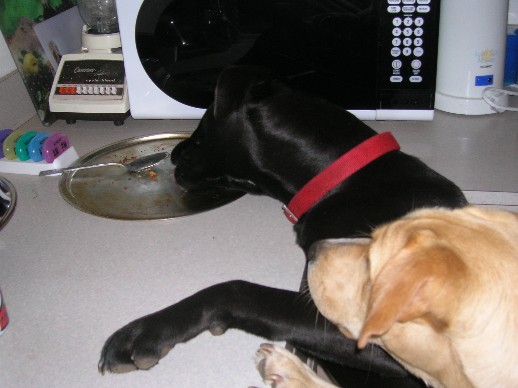
How is that different from my 11-month-old pups, who have grown considerably larger than the puppy in my profile picture? They don’t scream, but they do run full-out into the house, and within minutes they’re into something: papers set aside to recycle, laundry that hasn’t been folded yet, my husband’s shoes, and their favorite, anything made of cloth or paper.

The other night, I came out of my office to find papers scattered all over the floor, giant claw marks in our new tablecloth, and Annie, the blonde, sitting on the big chair, with potholders and napkins spread out before her like a banquet. After screaming at the dogs, I hollered at the husband about how he should have been watching “the kids.” He got mad and closed himself up in his office.

This, I imagine, happens in homes with toddlers, too.

I know dogs are not the same as children. They won’t grow up, move away and hopefully take care of themselves when they reach adulthood. But at this age, they’re both discovering the world and don’t understand why I keep prying things out of their mouths.

Would I rather have children? Not at 56. I don’t even plan to have puppies again. I just can’t run fast enough. But a couple of grandchildren who actually look like me? I’d go for that in a heartbeat.

Grandma Sue?

In doing research for my book, I’ve been reading articles about stepgrandmothers. The articles seem to come from fairyland. I read about the wonderful things one can do with the offspring of one’s stepchildren and think, yeah, right. Set up opportunities to get to know them. Take them out to the movies, have them stay overnight, telephone and write letters or e-mails, have long heart-to-heart talks, get involved in their soccer games, doll play, or whatever they’re interested in.

It all sounds very nice, but it never happened for me. Not having been a mother or even been around children much, I had no idea how to go about courting my stepdaughter Gretchen’s kids. Plus, we’ve always lived at a distance. Because Gretchen was divorced from the children’s father when they were little, whenever we visited there was a good chance they were with their father. Or they might be with one of their real grandmothers. They had two grandmothers and two great-grandmothers when they were young. Grandma Sue was just the woman married to Grandpa Fred.

I was only 34 when Stephanie was born, 35 when Brandon arrived 14 months later. My training was in writing and music, not early childhood relations. I truly “didn’t know nothin’ ’bout babies.” Maybe if I’d had those articles then, things would have been different. I could have been more like my Grandma Rachel, who was also a childless stepgrandmother. She married Grandpa Fagalde a few years after Grandma Clara died. Rachel dove into grandmotherhood full-force. She showered us with gifts, took great interest in our lives and made us feel loved to the nth degree. She was big, loud and eccentric, but we loved her. To us kids, she was our grandma.

I wish I could have been that kind of grandma. I know women who adore their stepgrandchildren. In fact, they never use that “step” word. But it’s too late for me to start over. If I ran into my adult stepgrandchildren on the street, I’m not sure they’d recognize me.

How is it for you? Have you had the strange experience of becoming a grandmother without ever being a mother? Do you have a warm, fuzzy relationship with the kids or is it awkward and distant? I’d love to know.

Childless by circumstance?

In her book What No Baby?, Australian author Leslie Cannold maintains that many women are “childless by circumstance.” They wanted to have children, but life worked against them. In today’s world, says Cannold, young woman, and also men, are busy getting their educations and building their careers in their most fertile years. They believe that good parents spend time with their children, but if they take that time away from work, they will lose everything they have worked for and never achieve their career goals. Although women are the ones who are usually expected to stay home with the children, men worry about these things, too. In a world where people who work only 40 hours a week are considered slackers, who has time to parent? Although some men are merely selfish, many who decline to become fathers are afraid they won’t be able to bear the financial burdens or that they won’t be good fathers. If the wife quits to become a full-time mom, will the man be able to support the family alone in today’s economy? What if he loses his job? What if they get divorced?

Cannold insists that people who are childless by circumstance, in other words who are not infertile and have not consciously chosen to be childfree, are not childless by choice. She suggests that major changes are needed in society’s attitudes and in the workplace to make it possible for people to work and properly care for families, too. Otherwise, the numbers of people who never have children will continue to increase.

What do you think? Does everyone have a choice? Do you?