The Male Point of View

My youngest stepson says he will never have children. He’s been pretty consistent about that, although he doesn’t give reasons.

Last weekend in Georgia, I talked to two men who were very open about their reasons. Alek, who runs a bookstore, is 40, unmarried and childless. He doesn’t want kids because he doesn’t like them, he says. I asked him what he’d do if he hooked up with a woman who wanted to be a mom. He replied that no woman who wanted children would want him. “I’m married to my work and I’m difficult,” he said. Okay.

Then I ended up in a cab driven by Massoud, with his wife Puran riding shotgun. They’re from Iran. Massoud has two daughters from a previous marriage and had a vasectomy eight years ago. Puran, who wanted children, had to have a hysterectomy four years ago, so they are childless, but seem very happy together. Why no more kids, I asked Massoud. “They take all your money and they’re nothing but trouble,” he said. I wonder what his daughters would think if they heard that. Anyway, biology has sealed the deal for them.

I know men who have agreed to fatherhood despite age differences, offspring from another marriage or misgivings about the whole deal, but I’m always surprised when a man states so definitely that he is not having any children, period, end of discussion.

On the heels of these conversations, I was thrilled to discover a new book, Nobody’s Father: Life Witout Kids, has been published in Canada. This collection of essays, edited by Lynne Van Luven and Bruce Gillespie, is a followup to Nobody’s Mother. Amazon has it for $16.95. I’m looking forward to reading it.

Childless men out there, I just have one question? Why?
Uh-oh, the stepkids are reading this

I have recently become aware that my stepchildren are reading this blog. Oh my gosh. I have been honest, even occasionally catty. It’s as if they have been reading my diary or listening in on my phone calls. I know this blog is public and I also know I am blessed to have Michael, Ted and Gretchen in my life. They have grown into interesting, loving adults. Maybe a little too interesting sometimes, but who isn’t?

Gretchen says I can say anything, that she has nothing to hide. Okay. The other night, when we were on the phone for 90 minutes, she told me she had always hated me because she thought her father was cheating with me while her parents were still married. What made her think so? Well, she had come upon a necklace that he gave me early in our relationship. I assured her I didn’t even know her dad when he was still married. I was dating someone else. I met Fred seven months after his wife asked him to move out. He had told me he had bought the necklace for someone else. I assumed that was his wife. Well, Gretchen was flabbergasted to hear that. Twenty-five years of wasted hate. It explains a lot.

We get along all right now, even though we have nothing in common but her father. Gretchen gives the best hugs, second only to her dad, except that she usually smells much nicer.

Unfortunately, Gretchen, Ted and Michael will never be my own children. They have a perfectly good mother back in San Jose. But if they need one in Oregon, here I am. And Michael, who was just here visiting, if you’re reading this, I hope you’re over your stomach flu. Ted, congratulations on your engagement to Shelly. She’s terrific, and it’s about time.

Dear readers, how about you and your stepchildren? Do you feel totally comfortable with them, hate them, or wear yourself out trying to win their love because they aren’t yours? Let’s talk about it.

Free to Bequeathe

Without children to be our natural heirs, we childless folks may struggle with what to do with our worldly goods when we shuffle off to heaven. To whom do we leave our photo albums? Who will care about my collection of antique ruby glass? But we are also free to do whatever we want with our stuff. As an old text called Family Systems and Inheritance Patterns notes, childless people often name outside beneficiaries and really tick off their families.

Many childless people leave their estates to good causes, such as scholarships, charities, animal shelters, medical research, etc. That’s pretty much what I plan to do.

But some folks go a little farther outside the norm. For example, George Bernard Shaw bequeathed millions to anyone who could devise a new alphabet that made more sense than the one we have. Louis da Camara, a Portuguese man with no family, picked strangers out of a Lisbon phone book to be his heirs. Ed Headrick, perfector of the Frisbee, asked that his ashes be molded into memorial discs to be sold, with profits to be used for a Frisbee museum. My favorite: Ruth Lilly, an amateur poet, left $100 million to a poetry magazine that had repeatedly rejected her work.

Another good one from the UK: A Mr. F left several relatives each “one penny as that is what they are worth as members of my family.” Show of hands: how many of us are tempted to do that? Me too.

How about you? Have you made a will? Who will inherit your earthly wealth? Did you know that in some states, including Oregon, where I live, stepchildren are not considered your legal heirs unless you write them into your will? What unusual bequests have you heard about or considered doing? Without children–and assuming the spouse goes first–we are free to bequeath as we please. Any thoughts?

Mom writers everywhere

I was relaxing in the lounge before teaching my second class at the East of Eden conference last weekend. A tall young woman with bobbed hair sat down beside me. I glanced at her nametag and said, “Oh, I have your book.” I didn’t tell her I got it because I failed to return the book club card on time; you know how that goes. She smiled at hearing I had bought her book, then told me it was her first time being away from home since her baby was born.

Ah, babies again. She said she was glad she had gotten the book done four months before she got pregnant. Now she can’t remember anything about it. Everything that happened pre-baby is lost in a fog. The baby has changed her life completely. And I thought, wow, this is the deal, the life change that never happened for me. Having someone you’re completely responsible for gives you a whole new perspective.

At this point, I figured mentioning how I missed my puppies would have been too trivial. I did mention the husband with Alzheimer’s. She nodded. “So you understand.” But I probably don’t. It’s different. She asked what I was working on. “I’m writing a book about childless women.” Thud.

In line at lunch, I mentioned my topic to a slender woman with the most gorgeous curly black hair. She hadn’t planned to have kids, she said, but when her father died, she changed her mind. At 33, she asked herself, “What am I doing?” Now she’s a mother.

Looking around the conference, many of the women were my age or older, having waited until their children were grown to start their writing careers. But it doesn’t have to be that way. We had two speakers Saturday night. The first started writing late, realizing that when her kids grew up, she ought to “get a life.” But the second, Pulitzer Prize winner Jane Smiley, never let her three children and three marriages stop her from earning a Ph.D. or writing more than a dozen books. In fact, when asked how the prize for A Thousand Acres affected her, she laughed. “I was four months pregnant. I was sick the day before I won the Pulitzer Prize, and I was sick the day after.” She already had a 14-year-old daughter, whose reaction to the award was typical of teenagers. “Huh. Cool.” You know how it is, Smiley said.

Do I?

Showing Off My Baby–I Mean Puppy

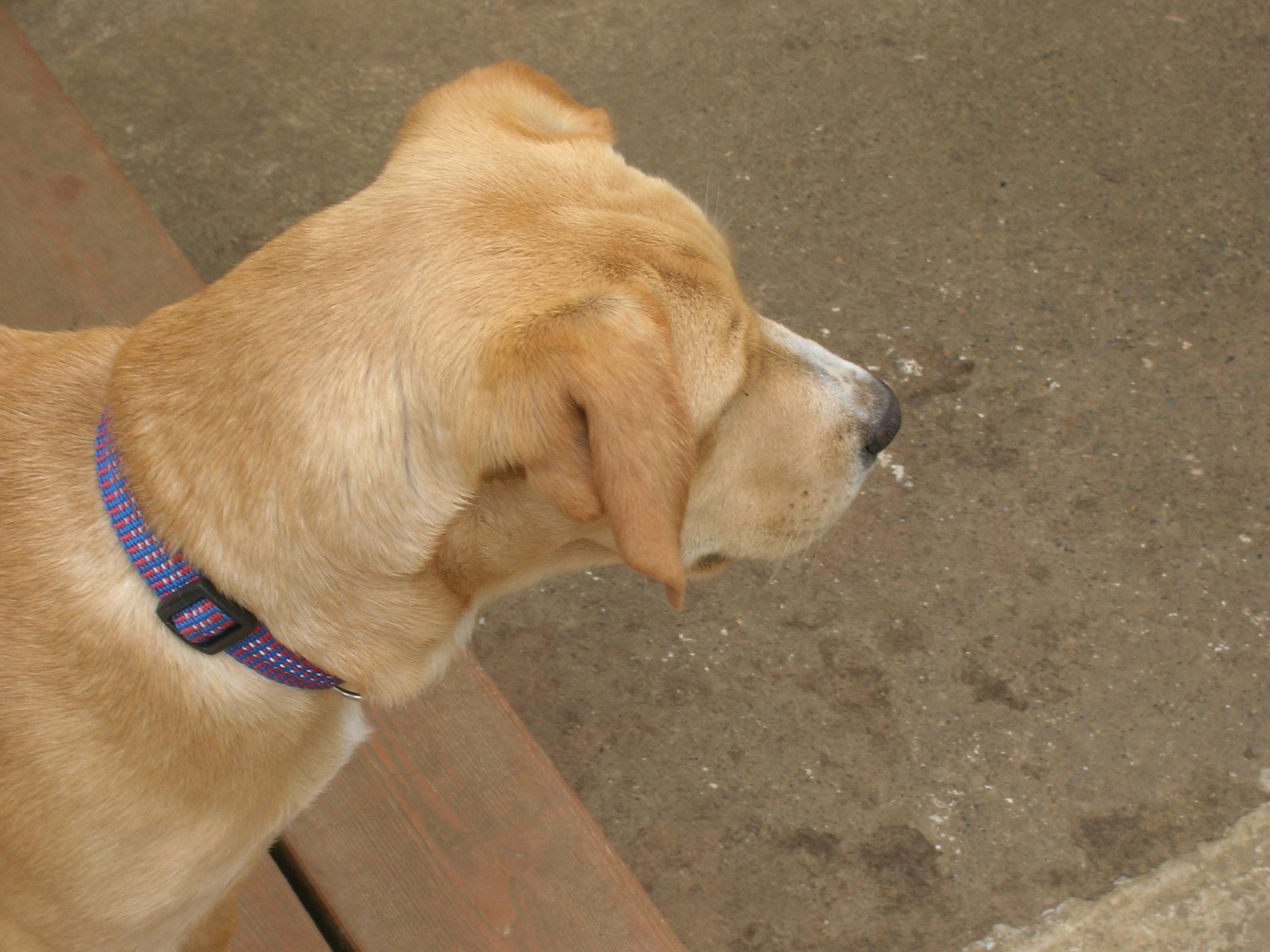
The other night I took my puppy Annie to church choir practice. We have a small informal group and these were the same people who threw me a puppy shower when we adopted two-month-old Chico and Annie in April. Now six months, Annie had just been spayed and we needed to keep her from roughhousing with her brother. Those two play hard, gnashing their teeth and tossing each other on the ground. Too much for a girl with stitches in her belly. Chico had spent the day at Dogport daycare, but they close at six and I needed to keep them apart, so Annie got to go for a ride.

She’s not the first dog or cat to visit the chapel, but I was glad to see Father Brian heading off on a walk toward the beach as I arrived. I doubt he would approve.

We practice in the chapel. I introduced Annie to Jesus, hanging on the big crucifix and let her make the rounds of all the women gathered in a semi-circle to sing. Before we started singing, I put her through her paces: sit, stay, down, come. Then Mary Lee, our director arrived. When she played the first chord on the piano, the dog stared in astonishment at all this sound coming out. I sat in a chair at first, then slipped to the floor to get closer to my dog. She seemed to like our singing. I laughed so hard I almost cried when Annie started singing, too. Punctuating our practice with “sit” “down” and “shh,” I sang my solos holding my music in one hand, petting the dog with the other.

Eventually I took her out to the car, but it was only the next day I realized how much I was acting like a typical new mom. I didn’t have to bring Annie into the chapel, but I wanted to show her off. Wasn’t she smart? Wasn’t she beautiful? Wasn’t she big? I had left my guitar at home so I could hold onto Annie. Annie, Annie, Annie. The whole practice revolved around my puppy. Is that not the same thing as a woman with her human child?

Regrets?

After yoga class yesterday, three of us got onto the topic of children. Nancy and I don’t have any offspring. Lynne has two. Do you have any regrets, asked Nancy as she smoothed her wild hair. Well, said Lynne, if I had it to do over, I don’t know. She explained that once you have kids, you always feel responsible, always worry about them. Her daughter is 40, and she still worries about her all the time.

Nancy, the only one of us still ovulating, said she really does not regret her decision to remain childfree, except once in a while when she sees a little brother and sister together. Then she feels a twinge of emotion–but not enough to change her mind.

How about me? I looked up from tieing up my mat. Well, yes, I have often regretted not having children. But lately, dealing with my six-month old pups, not so much. They laughed. I went on to detail some of the dogs’ recent exploits, including shredding the hot tub cover, destroying the screen door, eating the paint off the walls in the laundry room, and smearing mud all over everything while it was raining and they got bored.

However, I noted that I did wish I had adult children to hang out with and to help me with things. Nancy rapidly reminded me that many children don’t get along with their parents, aren’t around to help, live far away, etc. I know, I know, I know. But if I had children, they might be worrying about me the way Lynne worries about her kids.

But as for little ones? I think I’ve grown out of it. While we were doing our final relaxation, I heard the gym owner’s tots chattering in the other room. At that moment as they interrupted my meditation, I wanted to vaporize them. :-)Then I put them into the background with the potato chip delivery truck outside and went back to pretending I was a rock in a river on a sunny day.

Whatever we feel about childlessness, yoga tells us to focus on our breath, live in the moment and find that calm, peaceful place in our hearts. Breathe in, breathe out with a nice long ommmmm. What is, is.

Does It Take a Village?

I’ve been working on a chapter about old age without children. Who does one turn to for medical care, practical help, and emotional support? If we had children, we would hope to get help from them, but since we don’t, who will take care of us?

Some childless folks really aren’t worried about it. They’ve got siblings and nieces and nephews to help them. Others count on church groups or friends. Still others say they have set aside enough money to pay for their care. But some of us just don’t know what we’re going to do if we end up old and alone. I think we all agree we want to stay out of nursing homes if we possibly can and we want to be self-sufficient. It would be nice to have adult children to take care of us, but there’s no guarantee that they would be willing or able. Nor would we want to burden them with our troubles. So what should we do?

An increasingly popular option is to hook up with other aging men and women to take care of each other. This could be an informal arrangement: I’ll be your emergency contact,and you’ll be mine. It’s important to make sure someone you trust has power of attorney and the legal right to make medical decisions if you can’t. See your lawyer to set this up. A point to consider: If you’re both the same age, one of you might become disabled and not be able to help the other. So cultivate some younger friends as well as your peers.

Some people are participating in a more formal arrangement. Have you heard of Beacon Hill Village? I hadn’t either. It’s actually a neighborhood of people over 50 who pay to join and share all kinds of services. The idea is to allow people to live in their own homes with dignity and the help they need. It sounds pretty good. Read about it. A couple other similar communities are Dupont Circle Village and Kalorama Village.

I think the most important thing is to have some sort of plan. Nobody really wants to be alone, unwell and unable to get help. That applies no matter what age you are.

Stay well!

Mom Club strikes again and so do the dogs

My puppies are in timeout right now. They were so cute sleeping together atop the spa cover–until I looked out the window and saw them shredding it. I took a cue from Supernanny and shut them in the laundry room, not so much to think about what they did–they’re dogs–but to give them time to find something else to chew up and me time to stop being angry. Think they’ll get through the duct tape I used to patch the cover? You bet. And wait till their father gets home.

Still on the dogs, Chico literally chewed off Annie’s collar day before yesterday and chomped it into little pieces. I saw it hanging from his mouth, ran out and gathered the bits of cloth. I thought I got them all, but yesterday morning, I discovered that during the night he had barfed up the rest of the collar, including a plastic clasp. Yikes. I hear they calm down after the first year. I hope so. At least human babies don’t have teeth.

***

I opened my blogger screen this morning and what did I see? Baby pictures. Come on, Blogger, some of us don’t want to see babies right now.

***
At last weekend’s conference, I was having a fine time at the bar with a bunch of other writers when suddenly the conversation turned to children and I found myself sitting alone with my beer and basketball on the overhead TV screen while the others were huddled together talking about school, obedience, shots and other kid topics. Once again, the Mom Club had gathered and I was left out. Ever feel that way?

***
I did meet with agents and editors about the Childless by Marriage book at the conference. No good news yet, but it’s coming.

Brilliance will be delayed

Dear friends, I’m heading off to the Willamette Writers Conference tonight, and I have yet to find just the right inspiration for the Friday Childless by Marriage blog, so rather than bang out something worthless, I’ll get back to you next week.

Meanwhile, I don’t have children, but I do have dependents: an ailing husband and two high-maintenance puppies, so I know what it’s like to try to get away when you have people depending on you for everything. It’s almost impossible. For all those who kvetch about “breeders,” get off their backs. They’re doing a hard job, and if nobody had children, we wouldn’t be here.

Have a great weekend. I’ll be meeting with editors and agents, and I hope to report good news about the Childless by Marriage book when I return.
Sue

Who will inherit my stuff?

I am the keeper of the family heirlooms. I have my maternal grandmother’s silver tea set, handwritten recipes from her notebooks and her diamond engagement ring, my stepgrandmother’s poetry, both grandmothers’ china cups and saucers, and craft supplies and clothing from both my mother and my mother-in-law. In fact, I’m wearing my mom’s blue knit shirt right now.

Many mornings I sit in Grandma Avina’s wooden rocker softened with the pillows I crocheted for it and rock as I write in my journal. Occasionally I wonder what will happen to the many volumes of my journal after I die. Should I burn them to hide my secrets? When? Or should I keep them for future biographers, in case I became famous?

I recently worked out my will, and frankly the extra notes are more important to me than the standard bits about money and things like the car and house. I never had much money, so we’ll be lucky if I come out even in the end, and I’m happy to give wheels and lodging to whoever needs it. What I worry about are my writings, musical instruments, jewelry, photos, books, quilted wall hangings, the desk that Grandpa Al and Uncle Tony made for my mother’s brother long before I was born, the bookshelves that used to be in Grandpa Fagalde’s house, the statue of Our Lady of Fatima that my late godmother bought for me when I was a religion-crazed little girl, things like that. What about those miniskirts I saved because they were so cool? Or the photos from my first marriage? What will happen to these things? Who will sort them? Who will care?

It’s not really just a childless thing. If you’re lucky enough to have a son or daughter who understands and cares about the same things you care about, you might hope they treat everything with respect. But they might not. And with stepchildren, they really might not.

The truth is everybody’s stuff is up for grabs. Grandma Rachel never had kids of her own. Grandma Ann had two children and six grandchildren, but both ended up with young folks plowing through their things, throwing gobs of it away and offering the rest to anyone who wanted it. That’s how I got the china cups and a turquoise necklace that Grandma Ann probably never wore.

That’s how I got Mom’s clothes. I bagged the ones that fit and brought them home. My father, distraught from his loss, just wanted them gone.

Nobody cares about your stuff as much as you do.

Many of the women I have interviewed don’t worry about their stuff. When they’re dead, they’re dead, they say. How do you feel about it? If you don’t have children, who will sort through your stuff? This is a morbid subject, but having sorted too many dead relatives’ things, I know it’s an important one. How does the woman without children make sure someone cares for her treasures when she’s gone? I’d love to hear your comments, especially if you know of some particularly creative things women have done with their worldly goods.