Is the Declining Birth Rate a Real Problem?

Simone and Malcolm Collins have six kids and are hoping for ten, each produced by in vitro fertilization and delivered by C-section, because they believe the U.S. is heading for a crisis if people don’t start having more kids. 

A Washington Post article on the couple reports that the average fertility rate in the United States has not been above the 2.1 children per couple replacement rate since 2007, according to World Bank data. “Currently, no country in the developed world, barring Israel, has a fertility rate above replacement level, and, based on U.N. projections, by the end of the century, almost every country will have a shrinking population.”

They are not the only ones concerned that in the not-too-distant future, we will have empty schools and overflowing nursing homes with not enough people to do the work needed to run the world. The Collinses join a growing group of people, mostly firmly on the red side of politics, who decry the tendency to have fewer children as selfish and wrong. Today’s young people just want sex with no responsibilities, they cry. They play around until they’re too old to have babies. 

This, of course, ignores the many reasons people may not have children, including infertility, illness, lack of a willing or able partner, choice, and a wide range of situations that fall somewhere in-between.

Those favoring more baby-making include Vice President J.D. Vance, famous for his comments about childless cat ladies. “I want more babies in the United States of America,” Vance said at the March for Life on Jan. 24, in his first public speech as vice president. The Collinses are hoping to become part of a national “pronatalist task force.”

It’s a big change from the 20th century cry that our growing population would lead to disaster. Having too many people would destroy the land, and overcrowding would make life unlivable. Paul Erlich’s The Population Bomb was required reading when I was in school. Now, people are reading Empty Planet, about how our shrinking population is going to lead to big trouble.

Population growth has always been a cyclical thing.

One of my great grandmothers had 13 children. Another had seven. It was what people did back when most women saw few life choices beyond motherhood or the convent. Birth control and abortion were not easily accessible. If you had sex, you had children. 

Before the advances of modern medicine with its vaccines and antibiotics, many babies didn’t survive to adulthood, so it made sense to have more. I don’t know if any of my ancestors’ children died young. Everyone who knew them is gone now. But it seems likely.

My grandmothers each had two, plus one miscarriage each. Don’t ask me how they limited it. Who thinks about grandparents having sex?

My own parents married right after World War II, the height of the baby boom. With the war over, the world looked bright and shiny, the men had VA loans and GI bill money, and jobs were plentiful. It only took one income to buy a house and raise a family. So, they did. Two kids, sometimes three. My parents used condoms; my brother found them when he was snooping around. 

Values were different in those days. While married couples were expected to procreate and the only ones who didn’t were physically unable to, my parents made it clear pregnancy outside of marriage would RUIN YOUR LIFE. Girls who got themselves “in trouble” were shuffled off to a distant aunt or a home for unwed mothers to have their babies and give them up for adoption. Now, nearly half of babies are born to single mothers, and nobody cares. 

You’d think that would lead to more babies, but there are other factors. About the time I lost my virginity, birth control and abortion were becoming legal and obtainable. Women were moving into the workforce, demanding equal opportunities with men. Divorce became more common, sometimes leading to people marrying people who had already had their children and didn’t want anymore. 

It became quite possible for women to survive on their own without marriage and for couples to decide maybe they wouldn’t have kids. 

Fast forward to the grandchildren of the baby boomers. The birth rate has plummeted for many reasons. Young people are so busy finishing their education and building their careers they don’t get around to considering children until it’s too late. It costs so much to purchase a home they don’t know how they can possibly afford to raise families. Marriages may not last, the economy may implode, wars are happening, people are shooting children in the schools, and the climate is going nuts. Plus, no one can afford daycare.

In view of recent events, when so many people working at what seemed to be long-lasting government jobs are suddenly fired without notice, severance pay, or options for future employment, a lot of people are worried. If you’re not even sure you can support yourself, how can you support children? 

All of this leads me to wonder what will happen with today’s young people. How many will never have children because it just seems impossible? Will we see a new baby boom as the Maga wave washes away abortion rights and maybe goes after birth control next, as women and non-traditional couples see their equality fading away?

Or will the trend keep heading downward? Will people without children stop being the exception, the odd ones in the room who don’t have baby pictures to show? 

Is this all a lot of stewing about nothing? People will always have sex. Sex leads to babies, except when the body says no or we use some form of birth control. Contraception might become more expensive or more complicated to get, but it will be there. If you’re in a partnership where one wants to have children and the other doesn’t, changes in laws and availability may lead to more arguments but probably not to more babies. 

Nor will couples go back to the “Leave it to Beaver” lifestyle where the woman tends the home and children while the man earns the money. Nobody can afford it, and most women want their lives to include more than motherhood.

What do you think? Have you seen the attitude toward having children change? In what way? Do concerns about world population affect your decision in any way? What do you think it will be like twenty years from now?

Additional Reading

https://www.cdc.gov/nchs/pressroom/nchs_press_releases/2024/20240525.htm

Simone and Malcolm Collins want to make America procreate again – The Washington Post

Falling birth rates, why it is happening and how governments are trying to reverse the trend – Michigan Journal of Economics

Why birth rates are falling, and why that’s not a bad thing | Popular Science

**************************

The Childless Elderwomen are having another online Fireside Chat on Saturday, March 29 at 1 p.m. PDT. The topic this time: “Eldering in a Time of Collapse.” I have to miss this one, but the rowdy “Nomo Crones” (nomo for Not-Mother) are sure to have some interesting things to say on this topic. Find out more and register at https://gateway-women.com/gateway-elderwomen.

If you enjoy the Childless by Marriage blog, you might want to visit my Substack, “Can I Do It Alone?” at https://suelick.substack.com. Many of the readers there have never had children. 
Processing…
Success! You're on the list.

Different Generations Have Different Ideas about Having Children

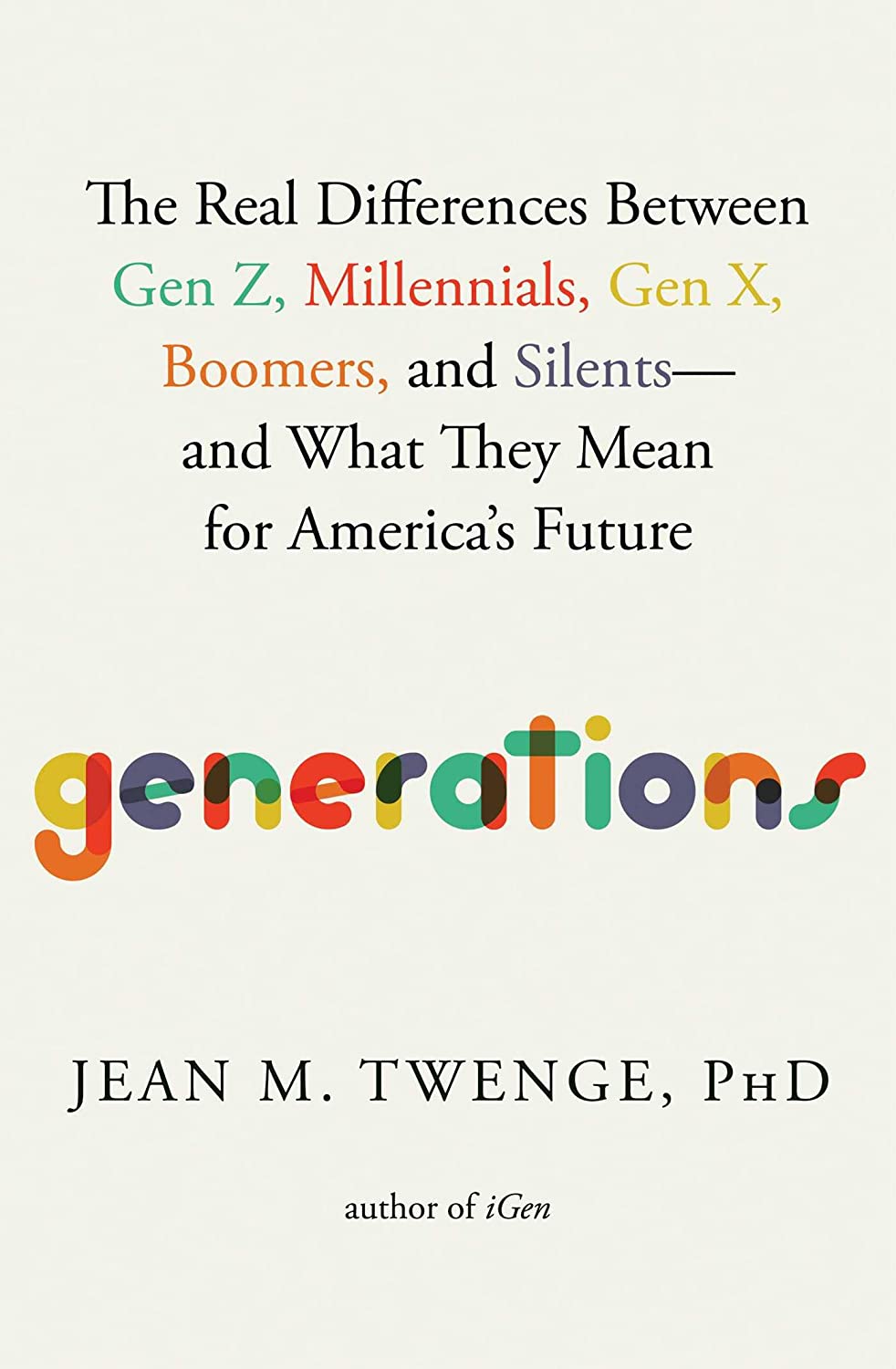
When you were born has a huge effect on how you feel about marriage and having children (and a whole lot of other things). I knew this in a vague sort of way, but the book Generations by Jean M. Twenge really opened my eyes. Gen X, Millennial, and Gen Z readers, I see you more clearly now.

The world is so different from when I was growing up as a baby boomer in the 1950s and ‘60s. Yes, I’m old, at least on the outside. On the inside, I’m still that long-haired hippie wannabe wearing mini-skirts and panti-hose and certain I would fall in love, get married and have children, just like all the other women in my family. Okay, not all. There were a few who didn’t have kids, but people didn’t talk about that stuff.

So much has changed. Birth control, legal abortion (until lately), women working outside the home as much as men, more people living into their 80s, 90s, and past 100, more young people going to college, student loan debt, the cost of living, LGBTQ folks going public and getting married, Internet, social media, smart phones . . . It’s not an Ozzie and Harriet world anymore.

A what? Exactly. Ozzie and Harriet Nelson were a real couple who had a black and white sitcom on TV featuring their lives with their two sons, Ricky and David. They were all musicians, and their problems were always resolved in less than a half hour, with time for a song at the end.

In her book, Twenge looks at each generation, from the Silent Generation (1925-1945) that was alive during World War II and their boomer children (1946-1964) through Gen X (1965-1979), Millennials (1980-1994), Gen Z (1995-2012), and what she calls Polars (2013-2029), the youngest generation. The changes are striking.

With each generation, people are waiting longer to get married, from late teens/early 20s in my day to an average of 28 for women and 30 for men now. And that’s just the average. Twenge writes: “Millennials are the first generation in American history in which the majority of 25- to 39-year-olds are not married.” They may or may not be living with a romantic partner, but marriage is pushed way down the road.

The trend continues with Gen Z, the oldest of whom are now at the height of their fertile years. The average age of women having their first child is 30, much later than earlier generations. But many millennials are choosing not to have children at all. It’s just not “required” the way it felt when I first married in 1974 at age 22. Couples are waiting longer, and many are deciding they don’t really want to be parents. They want to be free to work, travel, or do whatever they enjoy. Thanks to reliable birth control, it is easier to make that choice these days.

Even people who want children don’t see how they can do it, considering their student loan debt, the impossible cost of buying a home, and the equally impossible cost of childcare. They also look at the state of the world and think, really? I’m going to subject a child to that?

By the time they decide to get pregnant, they may be dealing with fertility problems, which leads to the whole world of fertility treatments, surrogates, and adoption, all difficult and crazy expensive.

How does this factor into being childless by marriage? In an era when more people are putting off having children or declaring they don’t want them, it’s more likely that one’s partner will be unable or unwilling to have babies. Of course, things get even more complicated when one partner has already had children and doesn’t want any more.

Twenge blames most of the changes over the generations on technology, including social media, birth control, and all the gadgets that dominate our attention. What do you think?

Generations is over 500 pages long and not a quick read, but it is fascinating, and I highly recommend it. If you’re much younger than I am, it could help you understand your parents and grandparents just as it helps me understand those born generations later than I was.

When I was young there was a saying: Never trust anyone over 30. We talked about the “generation gap.” Surely the generations have always disagreed on things. Do you think the differences are more pronounced now? Or is all this Gen X, Gen Z, etc. stuff nonsense?

Let me know what you think in the comments.

****************

During World Childless Week, I spoke on two panels, one about the image of childless people in the media and the other about aging without children. If you missed them or anything from World Childless Week, you can still watch the videos at https://worldchildlessweek.net.

Processing…
Success! You're on the list.

When Couples Put Off Having Children Until It’s Too Late

The photo offers the words "Not yet! Not ever? in a foggy sky over a green cliff with yellow flowers, wave spray and calm pale blue water.

You know how you think about going out, but you mess around and time passes and after a while it’s too late or you decide you’re fine with staying home? Deciding whether to have children can be like that.

We often hear these days that couples are delaying parenthood. While you’re busy going to school and building your careers, it doesn’t make sense to start a family. You want to travel and have adventures, too. You’re not ready for 2 a.m. feedings and constant responsibility. Time passes. Suddenly you’re in your late 30s or even early 40s and NOW, when your fertility is dwindling, you’re ready to have a family. Or maybe at least one of you has decided life is good just the way it is so let’s forget about babies.

Ring any bells?  

I was born in the post-WWII baby boom. Our fathers had just survived a war and were happy to be alive. Jobs were plentiful, college was not required, houses were affordable, and birth control was not a thing. Couples married in their early 20s and had children right away. They didn’t consider any other way of living. They would have their adventures after the children were grown.

Now, people are waiting longer to get married, averaging 27 for women and 29 for men. Maybe they’re being smart and skipping that “practice marriage” some of us older folk tried right out of college. The pressure to marry so they could have sex without worrying about out-of-wedlock pregnancy has faded away. Marriage is no longer required for sex or having babies.

It takes longer to “settle down” these days. You need a college degree to get any kind of job, need to work way more than 40 hours a week to establish your career, and homes are ridiculously expensive. Husbands and wives both have to work to pay the bills. And what about those student loan debts? So you put off parenthood. Years pass. You lose the urge. Or whoops, when you do start trying, you can’t get pregnant, and you dive into the miseries of infertility.

Does any of this sound familiar? Does it make sense? Are you caught between the clock and getting your life together? Are you putting off parenthood? Does your partner feel it’s too late while you still want to try? Is life just fine without children?

Has not yet turned into not at all?

Please share in the comments.

******

Mother’s Day is over. Hallelujah. I don’t know about you, but I have heard enough about the glories of motherhood. I want to tell you about something nice that happened to me. I was taking it easy on Sunday watching a TV show when my phone rang. John, a 90-year-old friend who used to sing in my church choir, told me I had been on his mind. He knew that Mother’s Day was painful for me because I’d never had a chance to be a mother. He wanted me to know that I would have been a wonderful mother. He was sure of it.

I don’t know how you all would have reacted, but I was touched and pleased. It was so sweet for this great-great grandfather who says his family is what keeps him going to think of me sitting alone in my house on Mother’s Day and understand that it could be a difficult day.

How did your Mother’s Day go?

Processing…
Success! You're on the list.

Conflict: Using Birth Control When You Want Kids

Are the new abortion restrictions being passed in some U.S. states relevant for us here at Childless by Marriage? As you probably know, Texas recently passed a law prohibiting abortion, for any reason, after the sixth week of pregnancy, about the time a heartbeat can be detected. At that point, many women don’t even know they are pregnant. Even if they do, by the time they make arrangements, it may be beyond the six weeks. In practical terms, most abortions are therefore illegal. At the moment, the Texas ban has been blocked while it goes through court challenges, but there does seem to be a trend toward more restrictive abortion laws.

I’m not going to argue pro-life vs. pro-choice here. I’m Catholic; you can guess how I feel, but I also realize that many women are going to seek abortions no matter what the law says, so why not make it safe for them to do it?

What does this have to do with being childless by marriage?

While researching my Childless by Marriage book, I discovered that far more women had had abortions than I ever suspected. For some, the abortion ended their only chance at motherhood; later circumstances kept them from having children. Some had abortions because their partners insisted that they did not want them to have a baby, at least not then.

According to the U.S. Centers for Disease Control (CDC), there are 189 abortions per 1,000 live births and 11.3 abortions per 1,000 women aged 15–44 years. More than half of those women are in their 20s, and most of those abortions are performed at around the 13th week of pregnancy.

Abortion is sometimes used as a method of birth control for those willing to take a chance that they will not get pregnant and that they can abort if they do. Now the women in Texas and other states where regulations are being tightened to the point of prohibiting most abortions may be feeling there is no way out.

Most of us have used other forms of birth control, including contraceptive pills and patches, IUDs, diaphragms, and condoms. These methods require at least one partner to take responsibility. Ideally, they should both agree that they want to use birth control. Diaphragms and condoms require the cooperation of both parties. The pill and the IUD may have negative effects on the woman’s health. They can also be discontinued without the male partner knowing. How many of us whose partners have been hesitant to make babies have been told by well-meaning friends or relatives to just stop taking the pill and have an “oops” baby? Most of us, I’ll bet.

We’re far from the days when our ancestors could only prevent pregnancy by giving up sex, but it can still be a touchy situation, especially when we want to have children and know that pill we’re taking every morning or that condom we’re using every time we have sex is making it impossible.

So I ask you:

1. How do you feel about conservative politicians eliminating abortion as a birth control method? Does that have anything to do with your situation?

2. If you’re using birth control, how do you feel about it? Do resent that pill, hate that condom? Does your partner insist you use them or just assume that it’s “take care of”? Are you able to discuss it freely with them?

Please share in the comments. You can be completely anonymous. This blog does not work without your input.

Thank you all for being here.

****

On an unrelated note, having Facebook and Instagram go down earlier this week made it clear that I can’t count on reaching you there. To make sure you always know when there’s a new post, please use the subscribe button to the right of this post.

Processing…
Success! You're on the list.

Book Review: The Female Assumption

The Female Assumption: A Mother’s Story: Freeing Women from the View that Motherhood is a Mandate by Melanie Holmes. CreateSpace, 2014.

I started out feeling that everyone who reads the Childless by Marriage blog must read this book. It’s loaded with information we all need to know while deciding whether or not to have children. Now I’m not so sure. Despite the fact that Holmes has three children, it leans heavily toward the childfree viewpoint and doesn’t much address situations where women who want children are unable to have them. Still, there’s a lot to gain from reading this book. I’ll let you decide.

The Female Assumption includes:

  • Convincing testimony that motherhood is hard. Holmes writes about the lack of personal time and space, the financial cost, and the opportunities lost while providing full-time care. Even though she tries to reassure her own children that she’s very glad to have them, I’d be wondering about that if I were them.
  • Clear information on birth control, including the various methods and myths about how they work. She also goes into abortion and “morning after” options.
  • A list of questions women should ask themselves before considering motherhood. If nothing else, read this section and think about how you would answer these questions, things like: why do you want to be a mother, how much are your feelings about this being influenced by other people, and how would you manage childcare and career if you did have a baby?
  • A discussion of how even in the 21st century, women still do most of the childcare and housekeeping. Until partnerships can become equal, women will still bear more of the burdens of motherhood.
  • “Dirty Little Secrets,” things mothers don’t admit out loud for fear their peers will hate them and their children will feel unwanted. Two examples: “Mothers yearn for time alone,” and “Your ‘stuff’ will never be your own again.”
  • How women are held to a different standard than men. Who questions the validity of male leaders or achievers who don’t have children, yet it happens with women all the time. Holmes suggests women are given an impossible choice: give up everything else to be mothers or live alone, childless, with work as sole consolation.
  • How the American workplace is behind the times, offering lower wages for women and failing to offer paid family leave.
  • The often-negative effects of parenthood on marriages.
  • Examples of successful women who never had children.

As I said, Holmes does not spend much time on infertility or women whose partners are unable or unwilling to have children. She seems to be encouraging readers to remain happily childfree. However, this book does contain a lot of useful information. Holmes really did her research. Read it and use what you need. Skim the rest.

As always, I cherish your comments. Go back and read some of the comments from last week’s post, “Are You Delaying Parenthood Until Conditions are Perfect?” We got some great ones. You can still join the discussion.

Motherhood didn’t used to be a choice

Prescribing birth control for unmarried women was not legal in the United States until 1972, the year I lost my virginity and started taking birth control pills. It only became legal for married couples as I was entering high school in 1965. When Roe V. Wade legalized abortion in 1973, I was 21.

A lot of things were different when I was growing up. In 1974, the year I married my first husband, Congress passed the Equal Credit Opportunity Act. Before that, it was difficult for women to secure credit cards or loans or buy their own homes. Can you imagine that now? What do you mean I can’t have a credit card in my own name?

I know most readers here are considerably younger than I am. In your lives, birth control and abortion have always been legal. As for women being able to run their own financial lives, how could it be any other way? But it was. Consider this: We weren’t even allowed to wear slacks or jeans when I was in school, only skirts. With pantyhose.

I’m reading a new book titled All the Single Ladies. Author Rebecca Traister takes us through the history of the women’s movement and the stories of a persistent percentage of women who choose independence rather than be bound by marriage. It’s heavy reading but fascinating. I will tell you more about it when I finish the book. I want to talk about people who prefer independent lives over married life, but what I have read so far sure makes me think about how things have changed.

Through most of history, women have not been considered equal to men, and they have not had the same rights as men. Traister quotes so-called experts from the 19th century who maintained our brains were not as big as men’s brains and who also said that if we stressed our brains doing jobs not suited to women we would damage our reproductive organs. Craziness, right? But women as recently as my mother’s generation truly saw few other choices in life besides being wives and mothers. Even when I came of age, I expected every relationship to turn into marriage and that would lead to having children. That’s what everybody did. I just wanted to be a writer, too. I’d do it while the kids were at school.

When women found themselves pregnant before marriage, it was a scandal. They had to get married in a hurry or go off somewhere to give birth in secret and give the baby up for adoption. Abortion was rare, dangerous and illegal until 1974, four years after I graduated from high school, four years after several of my classmates found themselves “in trouble.” Being a nerd with no social life and hyper-protective parents probably saved me from that.

I got married two weeks after I graduated from college. If my ex hadn’t put a monkey-wrench into the baby plan, I’d be a grandmother now. Early in our dating life, he hustled me to the student medical center for birth control pills. Those pills were a disaster. They made me sick, fat and depressed. I tried various types of pills. On some, I bled almost all month long. Others caused giant painful bumps to break out on my legs. I experienced the mother of all yeast infections because I didn’t know what to do and I didn’t dare tell anyone I was having sex before marriage. But I didn’t get pregnant. What if I had been born just a few years earlier?

Shortly before the wedding, I switched to a diaphragm. Every time I bought the contraceptive jelly for it, I felt like everyone in the store was looking and judging. Even after I got married.

And yet, I had so many more options than my mother did. I don’t know if she had sex before marriage. I don’t want to know. I do know she and my dad used condoms to stop having children after they had my brother and me. My snoopy brother found them in a drawer, but we never discussed it. God no. For us, The Talk about sex consisted of one word: Don’t.

Birth control took away the fear of pregnancy, both in and out of marriage. Plus, because the times were changing, I was able to work as a newspaper reporter, doing work that men used to do. I was always in debt, but I could manage my own affairs. My mother, perhaps your grandmother, did not have that freedom. She lived in a world where men controlled women’s lives and women’s destiny was motherhood.

Things have changed so much. It’s good, right?

We have so many choices now. Sometimes that makes it more difficult, especially when we find partners who don’t feel the same way as we do about having children. It used to take some doing to prevent the babies from coming. Now we have to fight for the right to have them. It doesn’t seem fair. Or is it more fair than it ever was before?

What do you think about all this? How have things changed in your lifetime? How has the availability of birth control and abortion affected your situation? Let’s talk about it in the comments.


Which is worse, no kids or a dozen?

The novel I’ve been reading, A Place of Her Own by Janet Fisher, takes place in the 1800s. It’s based on the true story of a woman who came to Oregon by covered wagon and settled not far from where I live. The heroine, Martha, married at 15, has one baby after another, 11 in all. She’d probably have had more, but her husband died. I almost want to add “thank God.” He was an abusive SOB.

But that’s not my point. The story takes place in the 1850s and ’60s. Martha has no access to birth control, abortion doesn’t even occur to her, and there is no such thing as a vasectomy or tubal ligation. If you have sex–and her husband isn’t going to take no for an answer–you have babies. She spends the 21 years of their marriage either pregnant or nursing. Think about that. One baby after another, with no way to stop them from coming.

There comes a point in the novel where she has had two babies die in infancy and discovers she’s pregnant again. “I don’t want to have another baby,” she cries. She already has so many to take care of and she can’t stand the thought of losing another one.

Her husband treats her horribly, at one point beating her with a whip. She leaves him for a while and tries to divorce him, but discovers the laws at that time  allow him to take all of their seven living children away from her. So when he promises never to hurt her again, she goes back. She has two more babies.

Why am I telling you about this when you and I don’t have any babies at all? Think about how few choices women had back then, long before they earned the right to vote. When Martha, as a widow, went to buy land, the guy selling it preferred to deal with her 11-year-old son because he was male.

Only in recent times have we had any say about whether or not we would get pregnant and have babies or when we would have them. When I was born in the 1950s, abortion and birth control were not legally available. Nor did women have many career options. Most became wives and mothers. They started their families young, long before age-related infertility might be a factor. We never heard about spouses refusing to have children. I’m sure it happened but not nearly as often as it does now.

Today we have so many choices it’s frightening. We make those choices and then we wonder if we’ll regret them later, whether it be birth control, abortion, vasectomy, or committing our lives to someone who is not able or willing to make babies with us. In these days when divorce is common, we’re often the second or third spouse, and our partners have already created families with their exes. They’ve had their children, but we have not. They want us to be happy taking care of their children, but it’s rarely enough.

Sometimes I wish we didn’t have so many choices. Life was less complicated in the 1860s. But to be honest, I would no more want to have 11 babies and have two of them die than I would want to have none. Also, considering the lack of choices back in the 1800s (when my great-great grandmother had 13 children who lived), why would any of us let anyone else decide this most important life choice for us now?

What do you think about all this?

***

Last week’s stepmom post has created quite a hot discussion. Take a look at https://childlessbymarriageblog.com/2017/01/12/he-already-has-his-kids-but-i-dont/.


Are we defying nature by not making babies?

Women’s bodies are baby factories. It’s not all we are, of course, but if you look at our bodies, they are definitely designed to produce babies. Our breasts give milk, our vagina is designed to take in sperm, the ovaries to produce eggs which unite with the sperm, and the uterus to provide a nest for the resulting embryo to grow into a baby. Somehow, when it’s time, the body knows how to send the baby out through wide hips and a cervix that expands tremendously. Women carry extra fat reserves to help nourish the babies they carry. Hormones flood our bodies to keep the process going.

Every month of our fertile years, our uteruses prepare a cushy space for a baby then flush it away through our periods. That monthly flow of blood is the reminder of what’s not happening in our bodies, that we’re not making babies. I had periods for 40 years. Mostly it was a nuisance, messy, painful, and embarrassing. I didn’t think much about how it meant I was not pregnant because I wasn’t trying to get pregnant. I was using birth control with my first husband, and my second husband had had a vasectomy. Between marriages, I was trying NOT to get pregnant, so the arrival of my period was a relief. But think about how amazing this whole system is and how different from men’s bodies, for whom it’s all about sex.

Of course, we’re not JUST baby machines. We think, we love, we create, we dance. We’re CEOs, doctors, lawyers, teachers, ministers, artists, actors, bakers, gardeners, and so much more. But we do it all with bodies designed for motherhood. In modern times, we can decide we don’t want to be mothers. Sometimes our partners make the choice for us. Sometimes something goes wrong and we can’t get pregnant or carry a baby to term. But four out of five women still have children. Why not us?

Every other animal reproduces without questioning whether or not to do it. But we humans with our fancy brains sometimes say, “No, I’d rather do something else.” Not to get all Catholic on you, but is this right? I would love to know what you think about all this. Women’s bodies are designed to have babies. What does it mean when we choose not to use those parts or let someone make that choice for us?