These Books Offer Three Different Views of Childlessness

Nulligravida by Saralyn Caine, 2021

How do you feel when someone declares they never wanted children and puts down the people who do want them? Me, I’m very uncomfortable, as if I need to defend my desire to be a mother or explain why I haven’t adopted or gone through IVF.

I recently quit reading a book titled Nulligravida, which is the medical term for a woman who has never been pregnant. I couldn’t get past the mean-spiritedness of so many of the poems and essays by author Saralyn Caine.

  • “Children are noisy, selfish, and dependent. They can’t help it, but I can help having that in my life.”
  • “I refuse to be a host to a parasitic entity squirming around in my belly. I refuse to have persistent migraines from all the screaming. I refuse to sacrifice my sleep and health and body and sanity.”
  • “There is no soul waiting/for me to be its mother./If there were, I’d have the desire.”

Caine implies that women who become mothers sacrifice themselves to these “selfish parasites” called children. She also bashes Christians and anyone who promotes parenthood.

We are all entitled to make our own decisions in this area. Caine’s words are valid for those firmly against having children, but as someone who grieves the loss of the children I never had, I just couldn’t read any more of this book.

Childless: A Woman and a Girl in a Man’s World by Fabiana Formica, Nianima Press, 2025

I had trouble with Fabiana Formica’s Childless, too, but not because of its contents. Its unusual format makes it a slow read.

Formica was never able to find a fitting partner with whom she could start a family. Nearing the end of her fertile years, she froze her eggs and picked out a sperm donor, but she ultimately decided she was not up to having a child alone. Much of the book consists of letters to her unborn child, whom she names Nia after her grandmother. She tries to explain why she couldn’t go through with it.

Fabiana was married once. Although she hadn’t wanted children before, she said, once they were married, she felt a physical yearning to have a child growing inside her. When she asked her husband if they could start trying to conceive, she received “a resounding “No!”

She writes: “From that dissonance, between the body that quivers for the seed of life, and the mind, witnessing a full-blown typhoon about to hit the abandoned island of love, comes the short-circuit. The void. The devastation.

“I’d chosen a man, an imperfect human being, made of flesh and blood and vague feelings. An adult child, much as I was, too, wrapped in concern for the preservation of our own images as solid, proud and strong individuals. These projections concealed the fragility of our unresolved and difficult childhoods, but no one dared speak of such heartfelt truths. When I’d met him, I’d never have talked about children—because I didn’t want them. To be a mother, until that moment, had constituted an outrage directed at my future, an obstacle to my destiny, an unnecessary burden on my presence in the world, a presence I envisaged to be very different from that of my mother.”

Her own mother didn’t want children and had several abortions before giving birth to Fabiana. She always told her that having a baby ruined her life. Fabiana didn’t want to make the same mistake. But now she struggles with her decision to abandon her frozen eggs.

“I must justify the pain of the decision to let go of this attachment to an idea, to a role I’d play in society by telling myself there’s another plan for me, beyond motherhood, beyond caretaker, beyond anything imaginable by society, or by my own social conditioned thinking.”

She admits she enjoys her freedom to travel and to put her career and herself first. She tells her baby, “I wonder if such freedom would be compatible with you, my sweet baby Nia. If a happy union in which a man wouldn’t take possession of me, or you, to make us his missing rib, might exist, a man who allows my body so much freedom that he wouldn’t see a baby as the fruit of his conquest.”

Formica met recently with Gateway Women’s Jody Day and writer Y.L. Wolfe for an online webinar. They discussed Formica’s book, the desire to control their own lives, the pressure to create traditional families, and prejudice against people who are not married or partnered. You can watch the recording here.

Wait Here by Lucy Nelson, Summit Books, 2025
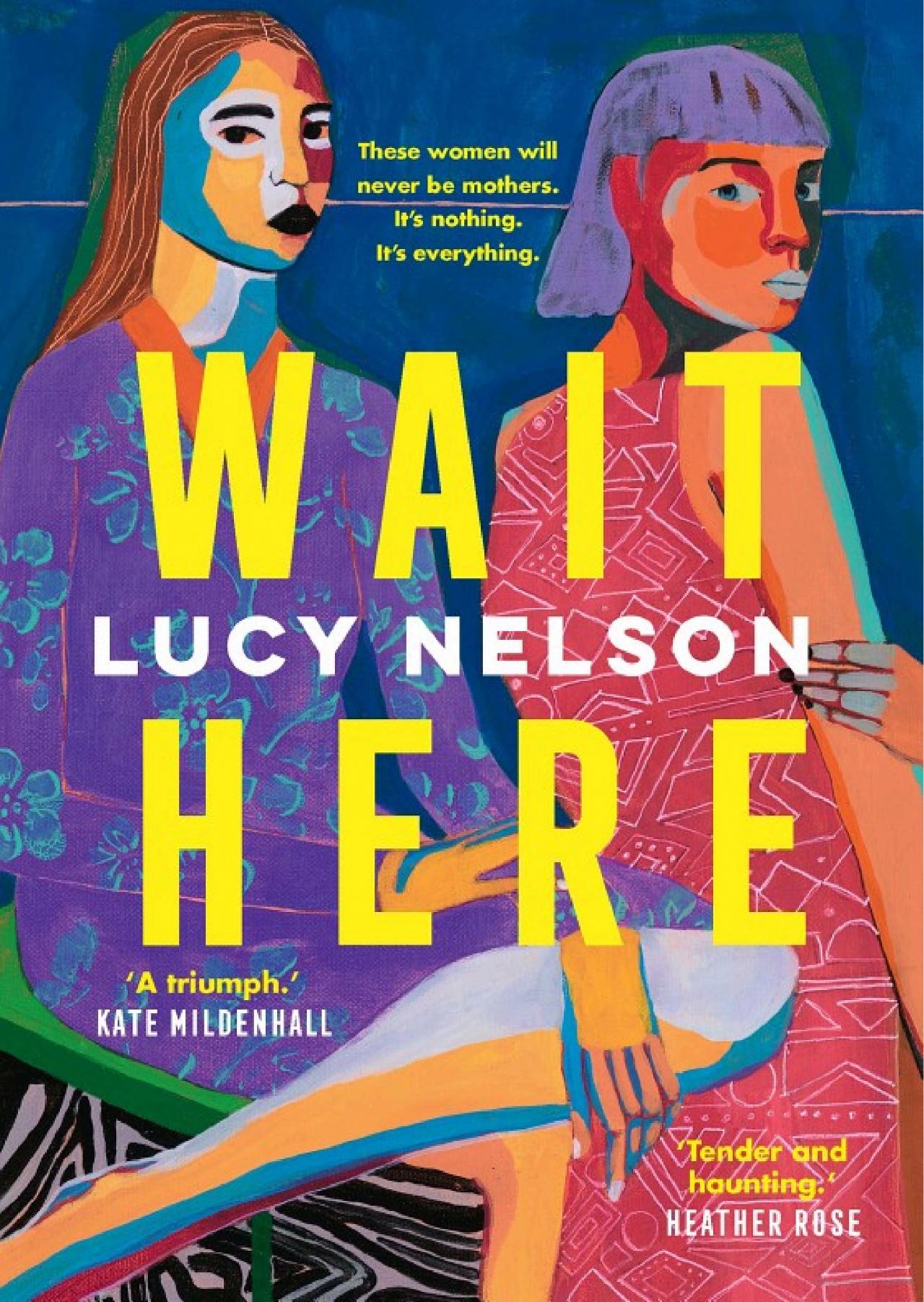
I have no qualms about recommending Wait Here by Australian author Lucy Nelson. This short story collection features protagonists who do not have children and probably never will. More important, these are great stories, quirky and original. In “Ghost Baby,” we read about a woman who looks for her aborted baby everywhere. In “The Feeling Bones,” Nelson uses the bones of the body to tell mini stories about her characters’ lives.

The title story, “Wait Here,” takes place entirely in a therapist’s waiting room. There, the lead character finds a comfortable oasis where she can invent stories and avoid what she has come to talk about: a baby she aborted or miscarried (it’s not spelled out). I truly enjoyed these stories. They’re easy to read and a relief for childless readers who are weary of fiction that always ends with the woman having a baby or heavy books that rail against the evils of pronatalism. This one is fun all the way through.  

When I first started writing about childlessness, there weren’t many books published on the subject. Most were Christian-oriented books on infertility that ended with a baby. It is good that writers are offering books now that show the many different faces of life without children.

Do you have any books recommend? Please share in the comments.


Three posts to go before I stop posting regularly here at the Childless by Marriage blog. What would you like to read here? I will keep up the website, with its reference list and an index of the 900 posts I have published over the years. You can also find me at the Childless by Marriage Facebook page.


If you want to know what I’m up to these days, visit my “Can I Do It Alone?” Substack at https://suelick.substack.com or friend me on Facebook at https://www.facebook.com/suelick

I Forgot How Childlessness Felt When I was Young

How will you feel about your childless journey 15 or 20 or 30 years from now? 

I’m finding out as I reread my Childless by Marriage book for the first time in years. I’m preparing an audio version. As I listen for mispronunciations, I feel like I’m hearing these stories for the first time.  

It’s not my voice. It’s a computerized voice but one that sounds like it could be me or my mom. She’s good. I listen, mesmerized, as this woman tells of the early years of my marriage, my angst over not having a baby, and my relationships with my stepchildren. 

This book came out in 2012, but I started researching and making notes in 1989, which was a very long time ago. I have changed. The world has changed.

Was there really a time when I thought and acted like a mom, when my youngest stepson, Michael, was a huge part of my life? How could I have forgotten?

How could I forget when my mother and I both had “grandbabies” at the same time? 

Did I really share so many personal and sometimes traumatic moments–My multiple experiments with birth control, having sex in the bathroom while the family watched a movie, sobbing at a women’s retreat because I would never be a mother, listening in horror as my stepdaughter told my husband he was a terrible father–I shared all that? 

Thank God my parents never read Childless by Marriage. The book is not just my story. I interviewed many childless women and did tons of research in the days when you could not find it all online. Chapters include information on infertility, birth control, vasectomies, the childfree movement, pets as child substitutes, losing friends when they become parents, and the physical and emotional effects of never having children. But I had forgotten how much of my own story was in there. It reads like a memoir in essays. 

I was still in the process of transitioning from newspaper reporting to writing creative nonfiction in those days. I hired an editor to look at the book. She said she wanted more of my story and less research. So, I changed it. Some of the stories are also included in my newest book, No Way Out of This: Loving a Partner with Alzheimer’s. I duplicated myself. I guess that’s okay. The words are different, and it came from a different time in my life. 

I was so young, still in my 30s, when I started researching childlessness. I was still having periods and still hoping that somehow I would have children. I was also trying hard to develop a motherly relationship with my husband’s kids.

As I reread this book, I miss them. I want to call each of them, hug them, and claim a place in their lives, but we have had no real contact since their father died 14 years ago. Michael visited once so I could show him where Fred was buried. Gretchen is a Facebook friend. Ted . . . nothing.

Ted, Fred’s oldest, was livid when he read the first ebook edition of Childless by Marriage. He threatened to sue if I didn’t take out the things I had written about him. I took them out. Considering what I said about Michael and Gretchen, it’s a wonder all three of them didn’t sue. I didn’t write it to hurt anyone, just to share how it is when you’re a childless stepmother, but not everyone sees it that way.

The kids are 46, 56, and 59 now. Gretchen is a grandmother. I will never see her grandchildren. I feel the loss. For a while, I was a mom of sorts. Does that mean I’m not childless? Well, the stepchildren stepped away. I never gave birth to my own kids. There is no child out there with my eyes and the name I gave him or her. No one calls me “Mom.”  

It’s not a sad book. Portions are funny, and most of it is upbeat. We learn there are many ways to mother and to nurture. I mothered my staff at the newspaper I edited. I mothered my students and the singers in the church choir. I mother my dogs, my plants, and l even mother the spider I capture in a cup and carry out to the lawn. I create books from a thought or a word and turn them into something lasting that I can share with the world. That’s not nothing. 

I know this is unusual post. Eighteen years into this blog, I’m running dry. I have moved on to writing about the issues of aging and living alone (see my Substack, “Can I Do It Alone?”) I have published many other books since Childless by Marriage came out.

I’m 73, widowed and live in an aging community where everyone has cats and dogs, but we don’t see a lot of babies. My friends’ grandchildren and great-grandchildren live elsewhere, so they’re not in my face.

When I see families having fun together, I still feel sad. I read about grown men and women taking care of their elderly parents and worry about who will do that for me. I daydream about having a family like other women my age. But I’m mostly caught up in the day-to-day of life here and now. 

My Childless by Marriage book, the one I honestly thought would make me famous (ha!) is good. I’m relieved. When a writer rereads her old writing, sometimes she shudders at what she let get into print. But no, I think it’s relevant and well-done, as beautiful as that six-foot tall, brown-eyed son I might have had, the one who might have called to take me out to lunch on this sunny spring day. 

One of the early books on childlessness, it is still the only one I know of that focuses on being childless because your partner can’t or won’t give you children. Well, except for my other book, Love or Children: When You Can’t Have Both. That one is a best-of-the-blog compilation; you might want to read that, too. 

Why am I telling you all this? Not to sell books (well, okay, if you want to buy one, I won’t mind), but to share how our views of things change over the years. You walk around saying, “I’m not a mom” when in fact you are mothering your husband’s kids or your students or your fur babies. You remember crying in the closest but forget how you also were free to travel the world, go to shows, eat at fancy restaurants, and make love in the living room. You look at some of the choices you made that led to being childless and think: Why didn’t I try harder? Why did I give in so easily to a life without babies? 

You wonder: Why am I not still a size 12?

I have been blogging here at childlessbymarriage.com since 2007. This is my 893rd post. I’m going for 900. Somebody do the math: At least 800 words times 900 equals . . . Oh my God. I had hoped to get to 1,000 posts, but my well has run dry. I have aged out of this gig. I won’t leave you altogether. We have seven more posts to go. I plan to redesign my Childless by Marriage website and keep you up to date on childless events, books, articles, and other things I might want to share. I will maintain my resource list. I will also continue my Childless by Marriage Facebook page. But it’s time. 

I expect to be finished with the audio book by June 1. I’m obsessed, so it’s going quickly. Page after page, this book reveals new things to me. I hope Childless by Marriage is a revelation to you, too, whether you already read it years ago or are hearing about it for the first time. 

Thank you for being here. Your comments are welcome and treasured. 

Processing…
Success! You're on the list.

Being an aunt is not the same, but it’s pretty darned good

Illustrating the fun aunts can have with nieces and nephews. Photo shows a little girl riding piggyback on a woman's shoulders in a park. Both wear pale blue jeans and pink jackets.

You know how people get to talking about their kids and we have nothing to say because we don’t have any? Being an aunt or uncle can get you into the conversation with more fun and less angst. 

I suppose it’s like being grandparents, except you’re still young enough to be fun. 

I spent Thanksgiving with great-nieces and nephews who gave me plenty to talk about. Especially the oldest one. R. and I dressed for Thanksgiving dinner together, exchanging fashion tips. We played games. I was a customer at her pretend restaurant and a student in her pretend school. I let her try my guitar, and I listened to the song she made up. I was not the one telling her to brush her teeth, get dressed, or quiet down. We exchanged confidences and terrific hugs. Last summer, we were the ones who went swimming together while the grownups watched. I’m not ready to be one of the grownups. I’m the aunt. A long-distance one who doesn’t get to see them often enough, but an aunt nonetheless.

This trip, the younger kids were so busy playing with each other it was hard to get their attention, but still I could love and admire them and be amazed at all they had learned since the last time I saw them. I could brag about them. And soon I will go Christmas shopping for them because these kids give me a place in the world of children that I would otherwise miss.

When people talk about their grandchildren, I can talk about the nieces and nephews instead of just reverting to my own childhood or talking about dogs and cats. It feels good.

I told my brother how lucky he was to have this beautiful family. Bless his heart, he said, “Well, you’re part of it.”  

We are not all lucky enough to have siblings and nieces and nephews, biological or honorary. Sometimes being around other people’s kids painfully reminds us of the children we will never have. We may also feel awkward because we don’t have experience with young people unless we work with them as teachers, coaches or caregivers. It’s easier to avoid them, along with the adults who ask why, if you like kids so much, aren’t you having any?

You may not be able to relate to kids at this point in your childless life. The wound is too tender. Or maybe they just drive you nuts with their noise and unleashed energy. On my trip, I saw a family with three boys and a girl who jumped out of their car like they were shot out of a canon. As they headed into Applebee’s for lunch, I thought thank God I don’t have to deal with that

As the aunt, I can give them all a big hug and go off on my free adult way. But as they grow, they will become real people I can talk to and love and brag about as part of my family. Maybe they’ll even help me when I get old. Maybe not, but it’s possible. 

If you don’t have any siblings with children, it’s still possible to be an honorary aunt to your friends’ kids. You just have to show up with arms ready for hugging, ears ready for listening, and a heart ready to play. For the parents, you can be an extra set of hands, respite when they need a break, backup they can count on. 

If you’re not up to it, that’s okay. But if you are, grab the chance.  

Have you heard of The Savvy Auntie? Back in 2009, Melanie Notkin started an organization called The Savvy Auntie that has blossomed into books, blogs, merchandise, and all kinds of support for women without kids who embrace their aunt status. Check it out at SavvyAuntie.com.

Aunthood (and unclehood) is what you make it. You can have a close relationship, none at all, or something in-between. But at least it gives you something to talk about when people are going on about their children and grandchildren or when you’re Christmas shopping and want an excuse to hang out in the toy department. 

In literature, as in real life, there are good aunts and bad aunts (ditto for uncles). Auntie Em in “The Wizard of Oz” was nice enough. Who wouldn’t love Aunt Bea from the old “Andy Griffith Show?” But the aunt in Anne of Green Gables? She was mean. Let’s hope we’re the good kind, the aunts who love their nieces and nephews and can match any proud grandma’s stories with stories of their own. 

Further reading

Great Aunts of Literature | Book Riot

Aunts and Uncles in Literature: The Good, the Bad, and the Downright Evil

How about you? Are you an aunt or uncle? Do you enjoy it? Why or why not? I look forward to your comments. 

Photo by Gustavo Fring on Pexels.com

*************************************************************************************************************

I will be participating in another Childless Elderwomen’s chat on Zoom on Sunday, Dec. 15, at noon Pacific time. Our topic is solo aging, and we have a bang-up panel of women you will love. If you register here, you can join us live or receive the recording afterward. This is a webinar, so you will not be seen or heard on screen.

I highly recommend Jody Day’s Substack post “The 3am bag lady blues.” She addresses that fear of growing old alone that many of us share.

Processing…
Success! You're on the list.