Nulligravida by Saralyn Caine, 2021

How do you feel when someone declares they never wanted children and puts down the people who do want them? Me, I’m very uncomfortable, as if I need to defend my desire to be a mother or explain why I haven’t adopted or gone through IVF.
I recently quit reading a book titled Nulligravida, which is the medical term for a woman who has never been pregnant. I couldn’t get past the mean-spiritedness of so many of the poems and essays by author Saralyn Caine.
- “Children are noisy, selfish, and dependent. They can’t help it, but I can help having that in my life.”
- “I refuse to be a host to a parasitic entity squirming around in my belly. I refuse to have persistent migraines from all the screaming. I refuse to sacrifice my sleep and health and body and sanity.”
- “There is no soul waiting/for me to be its mother./If there were, I’d have the desire.”
Caine implies that women who become mothers sacrifice themselves to these “selfish parasites” called children. She also bashes Christians and anyone who promotes parenthood.
We are all entitled to make our own decisions in this area. Caine’s words are valid for those firmly against having children, but as someone who grieves the loss of the children I never had, I just couldn’t read any more of this book.
Childless: A Woman and a Girl in a Man’s World by Fabiana Formica, Nianima Press, 2025

I had trouble with Fabiana Formica’s Childless, too, but not because of its contents. Its unusual format makes it a slow read.
Formica was never able to find a fitting partner with whom she could start a family. Nearing the end of her fertile years, she froze her eggs and picked out a sperm donor, but she ultimately decided she was not up to having a child alone. Much of the book consists of letters to her unborn child, whom she names Nia after her grandmother. She tries to explain why she couldn’t go through with it.
Fabiana was married once. Although she hadn’t wanted children before, she said, once they were married, she felt a physical yearning to have a child growing inside her. When she asked her husband if they could start trying to conceive, she received “a resounding “No!”
She writes: “From that dissonance, between the body that quivers for the seed of life, and the mind, witnessing a full-blown typhoon about to hit the abandoned island of love, comes the short-circuit. The void. The devastation.
“I’d chosen a man, an imperfect human being, made of flesh and blood and vague feelings. An adult child, much as I was, too, wrapped in concern for the preservation of our own images as solid, proud and strong individuals. These projections concealed the fragility of our unresolved and difficult childhoods, but no one dared speak of such heartfelt truths. When I’d met him, I’d never have talked about children—because I didn’t want them. To be a mother, until that moment, had constituted an outrage directed at my future, an obstacle to my destiny, an unnecessary burden on my presence in the world, a presence I envisaged to be very different from that of my mother.”
Her own mother didn’t want children and had several abortions before giving birth to Fabiana. She always told her that having a baby ruined her life. Fabiana didn’t want to make the same mistake. But now she struggles with her decision to abandon her frozen eggs.
“I must justify the pain of the decision to let go of this attachment to an idea, to a role I’d play in society by telling myself there’s another plan for me, beyond motherhood, beyond caretaker, beyond anything imaginable by society, or by my own social conditioned thinking.”
She admits she enjoys her freedom to travel and to put her career and herself first. She tells her baby, “I wonder if such freedom would be compatible with you, my sweet baby Nia. If a happy union in which a man wouldn’t take possession of me, or you, to make us his missing rib, might exist, a man who allows my body so much freedom that he wouldn’t see a baby as the fruit of his conquest.”
Formica met recently with Gateway Women’s Jody Day and writer Y.L. Wolfe for an online webinar. They discussed Formica’s book, the desire to control their own lives, the pressure to create traditional families, and prejudice against people who are not married or partnered. You can watch the recording here.
Wait Here by Lucy Nelson, Summit Books, 2025
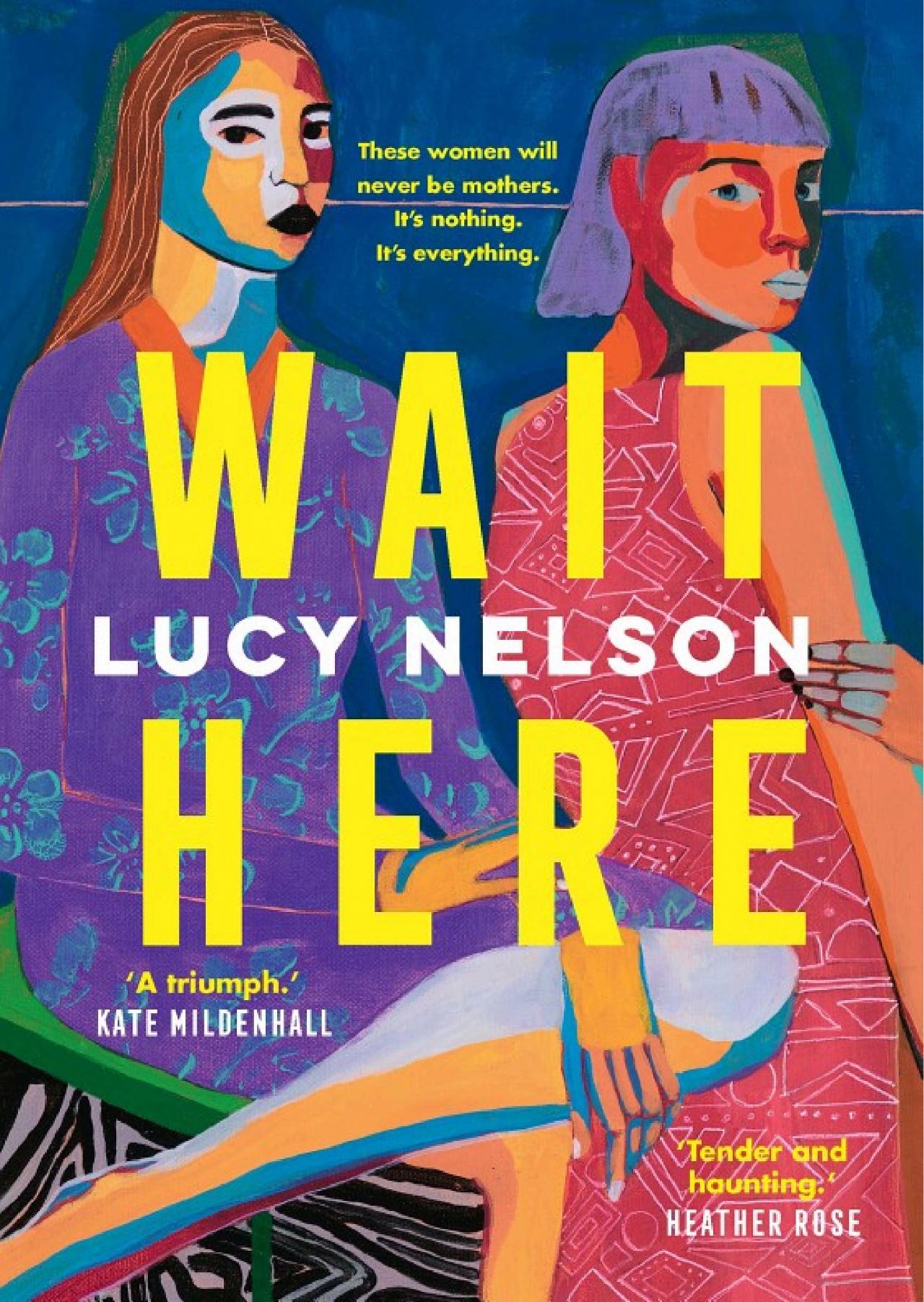
I have no qualms about recommending Wait Here by Australian author Lucy Nelson. This short story collection features protagonists who do not have children and probably never will. More important, these are great stories, quirky and original. In “Ghost Baby,” we read about a woman who looks for her aborted baby everywhere. In “The Feeling Bones,” Nelson uses the bones of the body to tell mini stories about her characters’ lives.
The title story, “Wait Here,” takes place entirely in a therapist’s waiting room. There, the lead character finds a comfortable oasis where she can invent stories and avoid what she has come to talk about: a baby she aborted or miscarried (it’s not spelled out). I truly enjoyed these stories. They’re easy to read and a relief for childless readers who are weary of fiction that always ends with the woman having a baby or heavy books that rail against the evils of pronatalism. This one is fun all the way through.
When I first started writing about childlessness, there weren’t many books published on the subject. Most were Christian-oriented books on infertility that ended with a baby. It is good that writers are offering books now that show the many different faces of life without children.
Do you have any books recommend? Please share in the comments.
Three posts to go before I stop posting regularly here at the Childless by Marriage blog. What would you like to read here? I will keep up the website, with its reference list and an index of the 900 posts I have published over the years. You can also find me at the Childless by Marriage Facebook page.
If you want to know what I’m up to these days, visit my “Can I Do It Alone?” Substack at https://suelick.substack.com or friend me on Facebook at https://www.facebook.com/suelick.
 Childless by Marriage