The Big Change Nobody Wants to Talk About

Menopause. The big bugaboo people don’t talk about except to make hot flash jokes. 

The deadline that looms for those desperately trying to get pregnant before they run out of time.

The end of worry for those who fear getting pregnant when they don’t want a children (or another child).

The Childless Elderwomen met last Saturday, and we talked about it in depth. We could have gone on for hours. We may not usually discuss it with anyone but our doctors, but judging by the more than 100 questions that our host Jody Day received beforehand, people are interested and anxious about it. 

Our panel ranged in age from 49 to 79, from Catherine-Emanuelle Delisle, who went into early menopause at age 14, to Maria Hill and I, for whom it has been decades since our period. Others are still dealing with the effects.

For all women, the arrival of the monthly period, the sloughing off of the lining of the uterus that was prepared for a possible baby, signals that they are not pregnant. For some, that’s a relief because a baby was the last thing they wanted, at least then in their current life situation. For those who wanted to be pregnant, it can be a mild disappointment or a crushing blow, depending on how long they have been trying and how difficult it has been. It’s a reminder that another month has passed, their attempts have failed, and at some point, their fertile years will be over. 

It can be hard, but it’s not the end of the world. In fact, as writer and life coach Maria Hill said, “Once you hit menopause, you’re really starting to come into your own.” Others put it more bluntly. We reach the point in life we were give far fewer “fucks” about things that don’t matter. 

Yes, the end of your monthly cycles means you will not be able to give birth, but it also ends the pressure to keep trying. It allows you to move on.

The preparation phase of menopause, called perimenopause, is a drag. Periods come and go willy-nilly, heavy one time, light the next, one after another, or with big gaps when you think maybe it’s over and then it’s not. You may suffer from hot flashes, weight gain, vaginal dryness, and mood swings, but when it’s over, ahhhhh. 

Imagine life with no more cramps, no more PMS, no more pads or tampons, and no more birth control. I’m here to tell you it’s nice. 

In our talk, we discussed sex, physical changes that come with aging, feeling invisible, and especially to men. We touched on hormones and other options for dealing with the discomforts of perimenopause and menopause. I won’t lie. Some people have a hard time.

But we also talked about feeling like we have a fresh start, almost as if we are back to being the girls we were before puberty. We have a better perspective on what matters. We can spread our maternal energy in many directions. In other words, life is not over. 

My own menopause occurred at the same time I was dealing with my mother’s death, my husband’s dementia, and my own bouts with Graves’ disease, a hyperthyroid disorder. I was also in grad school. It was hard to distinguish menopause from everything else.

My male doctors wanted me to take hormones. I’m afraid some OB-Gyns are only interested in patients who are having babies. Menopause? Give them a pill and send them out the door. I insisted on doing it naturally. There’s no shame in taking hormones or trying natural therapies for your symptoms, but if your doc refuses to listen to what you want to do, find another one.

Menopause happens at different times for different people. Catherine was a teenager. Stella Duffy menopaused early as a result of cancer treatment. For many, the signs of impending menopause may begin in their 40s and conclude around 50, but it varies. My mother claimed to still have hot flashes in her 70s. However it happens, you deal with it and go on. Life is not over. In many ways, you are entering a newer, freer phase of life.

Btw, your sex drive will not go away. With your periods over, you may feel lustier than ever. Just sayin’.

Jody asked us what we would say to our younger selves about menopause if we could. I said I would tell her that the lead-up is annoying, but menopause is good. You get yourself back again after being controlled by your ovaries all these years. You are not old and dried up. You are still a strong and powerful woman.

I say the same thing to you. There may be some turbulence along the way, but you’ll arrive at a better, calmer place. You go through the bloody fertility tunnel and come out the other side. Without a baby, yes, but you do come out, and it’s all right here in menopause land. 

For men reading this, don’t feel left out. Understand that menopause is like going through puberty in reverse. If someone you love is going through it, know it won’t last forever. She’s still the same person she always was. Offer hugs, bubble baths and chocolate, along with air conditioning or a big fan. 

Enjoy the video posted above. About halfway in, I share something I have never told anybody. I’m embarrassed, but someone had to say it. Check it out.

Your turn

  • Does it offend you that I’m writing about this?
  • Have you gone through menopause? How was it?
  • How do you feel about the end of your fertile years?
  • What does having no more periods mean to you, whether you’re looking back or looking ahead to the future?
  • What would you say about it to your younger self?

Four posts to go before I stop posting regularly and move on to other things. What would you like to read here?


If you want to know what I’m up to these days, visit my “Can I Do It Alone?” Substack at https://suelick.substack.com or friend me on Facebook at https://www.facebook.com/suelick

Childless by Marriage is all grown up–and we have an audiobook now

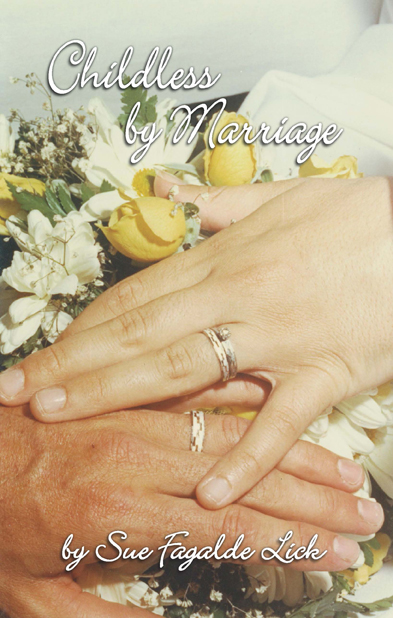
Childless by Marriage the book is a teenager. Published in 2012, it’s not the bestseller I had hoped it would be, but it’s a good book, and I hope it has helped people understand what it’s like to not have children because your partner is unable or unwilling to make babies with you.

It has lots of siblings now, including Love or Children: When You Can’t Have Both, which includes some of the most popular posts and comments from the blog between 2007 and 2020. There have been many new posts since then, and they are all archived on this site.

When Amazon offered a chance to create an audiobook version of Childless by Marriage, I went for it. The voice is computer-generated, not mine, but I like the way she sounds. This makes the book accessible to people who are visually impaired or who simply prefer to listen to books while they do other things.

While I was listening to the audio version, following along with a printed copy of the book, I discovered typos and words left out or misspelled. I was horrified. Typos in books drive me crazy, so I had to fix them. I spent many hours doing that last month. I am happy to report that I have now corrected and updated all versions, print, Kindle ebook, and audio. You can buy them at Amazon.com, or your favorite bookstore can order the print book through Ingram.

One good thing about producing books instead of children, especially in the computer age, is that you can go back and fix your mistakes. You can’t do that with most things in life. If for some reason you can’t have the children you wanted, you can’t go back to the original Word file and change the story of your life. Instead, you’re forced to make a tough decision. Do you accept the situation as it is, find a new partner, adopt, or try IVF? Do you settle for fur-babies or open a daycare? Do you grieve the loss or embrace the childfree life, or a little of both?

As I mentioned a couple weeks ago, I will soon stop blogging here. By the end of August, I will have shared 900 posts. If the book is a teenager, the blog is old enough to move out and live on its own. It’s time to let it go.

All of the posts will remain online for you to read, along with my resource page, bibliography, and updates on all things childless. I plan to create an index, but meanwhile, you can search right here on this page for whatever interests you.

I will also continue my Childless by Marriage Facebook page and would love to see some of you there.

At this point, my life is so far past the question of whether or not to have children that it’s time to let younger writers take the stage. There are many of them with so many more books, blogs, podcasts and support groups for people who are childless not by choice.

We even have a World Childless Week, hosted by Stephanie Joy Phillips, which offers tons of talks and workshops, readings, and resources, all online. This year it will be Sept. 15-21. Visit https://worldchildlessweek.net for more information.

One of the strongest voices in the no-kids community is Jody Day, founder of Gateway Women and author of Living the Life Unexpected. She has passed her own torch to Katy Seppi, who continues the work as The Childless Collective. Meanwhile, Jody has turned her attention to childless older women and is doing wonderful work there. Read her newsletter and subscribe to her Substack, https://jodyday.substack.com.

Not so long ago, people didn’t talk about childlessness. If someone didn’t have children, there were whispers about possible infertility—poor thing—but no one said anything out loud about it. But times have changed, and our numbers have risen. We can share our stories without shame so people can know and understand. No more secrets.

Question: As I prepare my last few posts, what do you wish someone had told you as you faced the possibility of life without children?


Nomo Crones meet next week

Jody Day hosts quarterly “Childless Elderwomen Fireside Chats” with women from all over the world. I have been lucky to participate in most of them. We have discussed everything from aging alone to how to deal with obnoxious questions about our parenting status. On Saturday, June 28, at 11 a.m. Pacific time, we “NomoCrones,” as Jody calls us, will discuss the often-buried subject of menopause and life beyond our fertile years. As always, it will be lively, with plenty of laughter and probably some tears. You can register to join us anonymously at bit.ly/gwe-meno. You will not be seen or heard, but the chat is always a big part of the festivities. The session will be recorded, so you can listen live or whenever you want to.

Meanwhile, Jody has published a terrific post about menopause and aging without children. You can read it here.


If you want to know what I’m up to these days, visit my “Can I Do It Alone?” Substack at https://suelick.substack.com or on Facebook at https://www.facebook.com/suelick

Guest post: Aging Without Children

Dear readers,

While I’m goofing off in Tucson, I’m giving this week’s post to Lisa Manterfield, author of Life Without Baby: Surviving and Thriving When Motherhood Doesn’t Happen and the blog of the same name. Although she addresses her comments to women, men can benefit from her advice, too, sans the bit about menopause. Enjoy. I’ll see you next week. As always, your comments are welcome.

Sue

Aging Without Children

by Lisa Manterfield

Lisa Manterfield picWith luck, we will all grow old eventually. However, aging without children holds a unique set of challenges that our parenting counterparts don’t have to face. Our experiences differ with the milestones we hit, such as menopause, as well as those we miss, such as grandparenthood. And while most parents assume they will be cared for by their children in their twilight years, for those of us without offspring, dying alone and being forgotten are perhaps two of our biggest fears. There’s no doubt that these fears are legitimate While we cannot control the future, we can control our awareness, preparation, and a shift in perspective that can help alleviate some of the concern and uncertainty.

Hitting the milestone of menopause can feel like the last cruel barb thrown up along this journey. Just when you think you’ve come to terms with not having children, your body pulls out its rubber stamp and seals the deal. This “official” end of the possibility of biological motherhood marks the final and ultimate loss of what might have been. You may find yourself grieving all over again, not only the loss of motherhood, but regrets about the paths not taken.

Our society isn’t good about helping people grieve intangible losses, so we have to give ourselves permission to reflect during this time and to mourn the losses we feel. Perhaps one of the most valuable lessons I learned on my own journey of coming to terms with the fact that I would never be a mother is the importance of creating an ending and allowing myself to grieve. For many of us, the possibility of motherhood often doesn’t go away until menopause hits, and we’re left hanging with that hope that it could still happen. Drawing a line in the sand and saying “this is where it ends” allows us to move forward into grief and to deal with our loss in a way that feels right to us (and not how society thinks we should handle it!)

But then what? What about that misty future without children? What about that unknown territory of growing old alone?

Perhaps one of the biggest fears many of us face when looking at a future without children is having no one to care for us as we age. We picture ourselves shunted into a low-cost care facility where decisions about our healthcare are made by strangers. We imagine we will die alone without a single familiar face beside us.

Unfortunately, in this messy old world, few of us have a say in how we’ll shuffle off this mortal coil. The reality is that fate, illness, dementia, and catastrophe seem to randomly select whom to bestow their gifts upon. We have little control in how we’ll exit or who—if anyone—will surround us when we go. So, with that happy thought, let’s talk about aging.

I suspect that those of us without children spend a lot more time than most people worrying about what will become of us later in life. Many parents assume their children will take care of them as they age. But if you’ve spent any time in hospitals and nursing homes, you know that parenthood is no guarantee of elder care, and many, many elderly people spend their final days without the company and care of the children they’d counted on. Ensuring care in your old age and having someone to carry out your last wishes is not a good reason to have children, but it’s another great reason to have friends.

As I’ve watched my own mother, a widow for many years, move into her 80s, I’ve come to see how important it is to nurture a circle of good friends. But, it’s not always easy to make new friends when you’re not moving in mommy circles and don’t have shared activities, such as PTA or kids’ sports, so how do you develop real connections, the kind you need when you’re asking someone to step in during your time of need?

Rather than trying to seek out other childless women and then looking for common interests, try starting with the common interest and seeking out the people you’re drawn to. That might mean joining a small group, such as a book club, exercise class, or adult education class, something that meets regularly so that you get to know each other better over time. At each meeting, challenge yourself to get to know one new person a little better. Start with the easy questions, like what do you do for work (and be sure to go in with some stock answers for the inevitable “Do you have kids?” question.) You’re looking for common ground, so over time, ease into conversations about hobbies and special interests. As the friendship develops, look for ways to make a more personal connection outside the group. Invite her to meet for coffee, a walk, or a drive, something where you can enjoy some quality one-on-one time and get to the deeper conversations that will strengthen your connection.

If this sounds like a lot of work, it is! But so is family, and these friends are the “family” we’re choosing. As with blood family, there’s no guarantee these friends will be there for you as you age, but I do see a future where seniors will help one another. Lately, I’ve been hearing about retirement villages where able-bodied residents help those who aren’t mobile, and local volunteers are assigned as advocates.

I’m also hearing more about older women living together to support one another, and networks of single, divorced, and widowed friends checking in on each other. A different kind of family is being created and a little effort now can help alleviate some of the worry about spending our later years alone. But it won’t happen by magic and it’s up to each of us to nurture the relationships with the people we’d like to have around as we age.

******************

Lisa Manterfield is the creator of LifeWithoutBaby.com, online community that provides resources, community, compassion, and support to women facing a life without children. She is the author of Life Without Baby: Surviving and Thriving When Motherhood Doesn’t Happen and the award-winning memoir I’m Taking My Eggs and Going Home: How One Woman Dared to Say No to Motherhood. She lives in Southern California, with her wonderful husband (“Mr. Fab”) and overindulged cat, where she is working on her latest novel.