The Birth at the End of The Novel Made Me Cry

. . . and not because I never had my own

The novel I just finished ended with the birth of a baby. 

Of course it did. In this type of feel-good fiction, even the people who think they can’t have children end up having them, and everyone is delighted. Just as people fall in love, overcome various obstacles, and end up happily ever after, surrounded by friends and family who adore them. 

To be honest, I want that. Don’t you?

Too bad it’s fiction. I won’t name this novel for fear of spoiling it for you.  

I will give credit to the author for bringing a childless woman into the picture. The new mom tells her childless sister-in-law, “My daughter needs a guardian angel, mentor, teacher, friend, a role model. Someone who is her strength. Someone she can always depend on and look up to. . . . Will you be Elizabeth’s godmother?”

Of course she will.

As I savored the ending through my tears, I cursed the author for making me cry. Baby-happy though she may be, at least she recognized the pain of those of us who don’t have children.

I suspect this “childless” godmother will marry her true love and miraculously become a mom in the sequel.

Moms and non-moms don’t always get along that well in real life. So often, they make wrong assumptions. A mother friend I’ll call Jo and I were talking about how misunderstandings arise between friends over having or not having children. One of her close friends assumed that when Jo became a mom, she would not have time for their friendship because moms’ lives are all about their kids.

“There was so much more to my life,” Jo protested. “I was still me.” 

At the same time, mothers make the mistake of assuming those of us without kids hate children and don’t want to be around them. That’s not true. I would love to be a godmother.

Kids are magical in the way they see everything with fresh eyes. Their excitement and their honesty are refreshing. Sure, they’re messy, noisy, tactless, and sometimes a pain, but so are we. Yes, seeing yours might remind me that I’ll never have my own, but does that mean I have to be kept apart from ALL children? Let me in.

It’s not only parents and non-parents who fail to communicate. People who are at different stages of life also misunderstand each other.   

That’s one of the reasons I’m planning to stop writing new posts for this blog after a couple more. My 900 posts will remain here for you to read whenever you want. I’m even going to create an index.

As a baby boomer who came of age in the late 1960s and early 1970s, I’m just not in the same place as young women struggling with the realities of childlessness now. I’m way past the possibility of having children. I’m not married or dating. My peers aren’t having babies; they’re welcoming grandchildren.

With menopause 20 years in the past, I feel as if I have already shared all I had to share about my childless journey. There are other, younger writers doing a better job of it now. 

That does not mean I don’t feel sad when I see families doing things together and know I’ll never have that. It does not mean I don’t feel grief and a bit of regret for how things turned out. It doesn’t mean I don’t see other women making the same choices I made and want to scream, “No! Don’t give up your chance to have children so easily.” 

It doesn’t mean I don’t feel like a slacker sometimes because I was physically able to reproduce, unlike women who are unable to conceive or carry a pregnancy to term. Unlike couples who go through hell trying to have a baby and still come out with empty arms. Compared to someone who bought a crib, chose a name and felt a baby kick, then lost that child, what have I got to complain about? 

I chose men who didn’t give me children, that’s all. I should have known better than to marry my first husband, but I was young and naive. My second husband, Fred, was too wonderful to give up. I believed his three children would give me all the motherhood I wanted. They didn’t.

Still, there is pain. There will always be pain.

When a friend brings her daughter to open mic to sing a duet and I know I will never do that, when a daughter rushes to the hospital to help her ailing mother or father and I don’t know who will come for me, or when couples post pictures of their kids and grandkids while I’m posting selfies, I grieve my situation. 

But do I think about it every day? 

Not anymore. Nor will you eventually. Age makes it easier to accept how life has gone. It really does.

As for the blog, you need someone who is dealing with it now in today’s world. So much has changed since I lost my virginity in 1972. I will offer you a list of other blogs and Substacks that will more than fill whatever vacancy is left by my lack of new posts. I will also beef up my resource page so you can find whatever you need in one place.  

Back to the novel: I wish I had played a bigger role in the lives of my stepchildren, nieces, nephews, and young cousins. I lived far away, and I was always working. Care for my in-laws, my parents and my husband in their final years took all of my energy. Now, these young family members barely know who I am. 

I regret that as much as I regret not having children. 

I appreciate the new mother in the novel making the childless aunt feel welcome and included.  

This is fiction, but I hope we can be more understanding of each other in real life. 

How do you feel when you read books where people are having babies?

Additional reading

Bridging the Gap Between Parents, the Childfree and the Childless

How Moms and Non-Moms Can Come Together | Psychology Today

To find books where people aren’t all having babies, visit the NoMo Book Club, https://www.instagram.com/thenomobookclub


If you want to know what I’m up to these days, visit my “Can I Do It Alone?” Substack at https://suelick.substack.com or friend me on Facebook at https://www.facebook.com/suelick

Thanks for reading Childless by Marriage!
Realistic childless role models, real or fictional, are hard to find

The last novel I read, titled The Way It Should Be, was enjoyable but typical of the prenatal slant we usually get. Early on, newlyweds Zara and Chad discover Zara carries the gene for a fatal disease she could pass on to their children. She’s thinking they should not get pregnant. But he really wants a family. Will he leave her if she can’t give him sons and daughters? Before they can think twice about it, the children of a troubled family member fall into their laps. They’re adorable, and eventually they adopt them. Easy-peasy. Not realistic. I like a happy ending, but it would have been a more meaningful book for me if Chad and Zara had been forced to deal with their situation as potential non-parents and how that would change their lives.

Have you read any good books with childless characters lately? Sometimes it seems that every adult character we encounter in books and other media has children. But that’s not how it is in real life. The NoMo (non-mother) book club was formed to highlight books for those of us who are not parents. They have compiled quite a list. Visit their site at https://www.instagram.com/thenomobookclub.

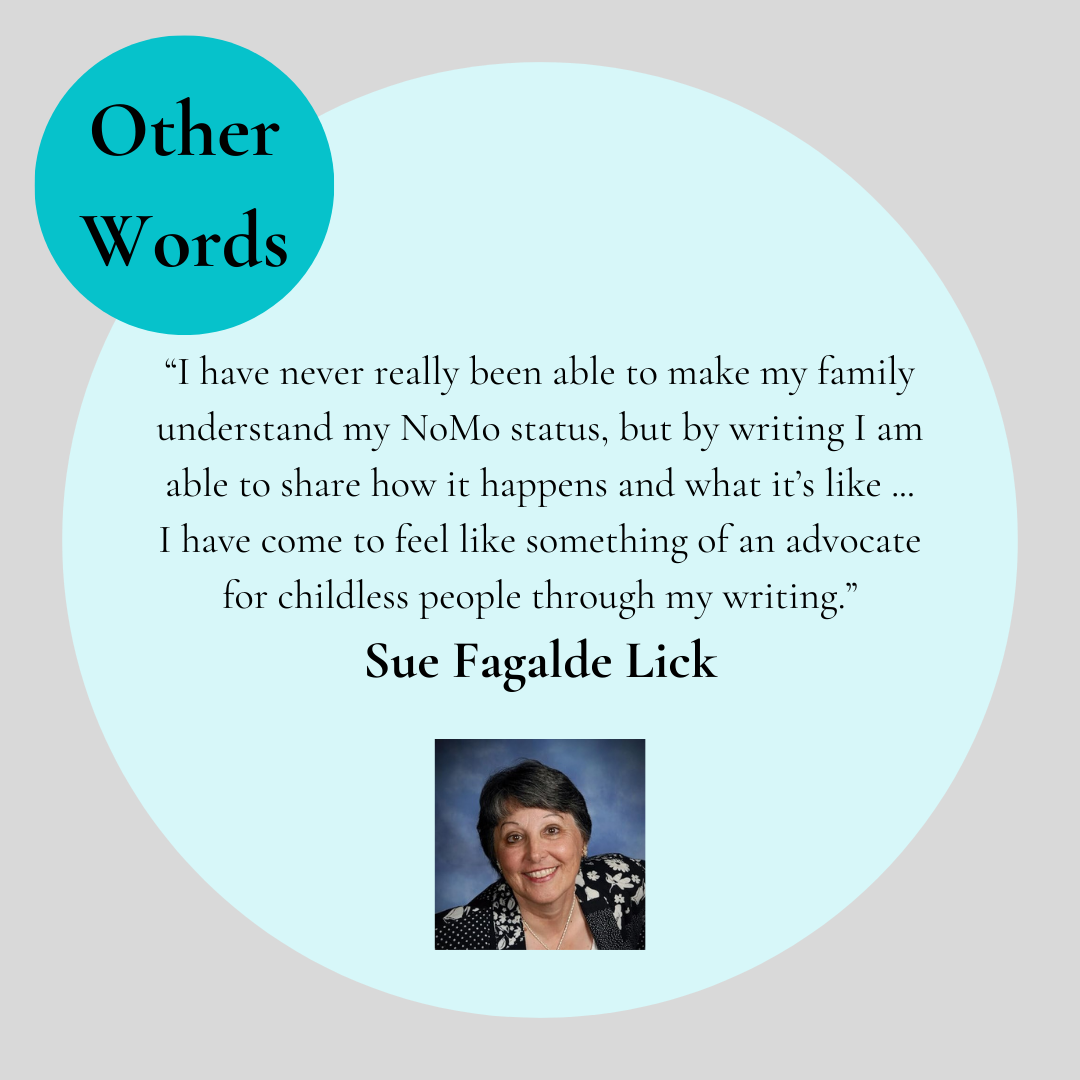
Book club member Rosalyn Scott has started a new feature there called “Other Words,” where she interviews childless authors. The site goes live this Saturday, Jan. 13. and includes an interview with me about my books and writing. The image shown here includes a quote from that interview. I look forward to reading all the others. I know a few of the authors, but most are new to me. Give it a read at https://thenomobookclub.wixsite.com/otherwords. Visit the nomocrones instagram site for some good reading ideas. If you have a favorite book that fits the “NoMo” category, let the book club know at thenomobookclub@gmail.com.

Speaking of books, have I mentioned that I have four coming out this year? One of them is the next in my series about PD (no kids!) and her friends at Beaver Creek, Oregon. Two more are poetry books, and the fourth is No Way Out of This, a memoir about going through Alzheimer’s Disease with my late husband. It’s nuts. But could I say no to any of my dream publishers who wanted to publish my work? Heck no. It will be an interesting year of proofing covers and pages, publicity and marketing, giving talks, and trying to find time to manage the rest of my life. If I had children, they would be badly neglected.

It’s like giving birth to quadruplets. At any particular time, one is crying, one needs a diaper change, one has a fever, and the other has just spit up all over me. I’m raising books instead of people. How about you? What are you raising this year?

On Dec. 20, the childless elderwomen held their fireside chat about childless role models. What most of us decided was that although we could name some famous people without children, we didn’t have many real-life role models to follow. When we were of childbearing age, no one talked about why some people didn’t have children. Rumors were tossed around, but no one sat down and had an honest discussion about it. Now, we have become role models for each other. Perhaps you younger readers can be role models for us. I think the lesson to be learned from this is to talk about it. If you know someone who hasn’t had children, ask them in a quiet, private moment if they mind chatting about it. You could tell them about your own situation and say you’re seeking advice about what it’s like. We have to stop the silence.

Meanwhile, here’s a link to the video. https://jodyday.substack.com/?r=ejjy9&utm_campaign=pub&utm_medium=web It’s a little over an hour long.

I welcome your comments, and I hope your new year is starting out well.

Sue

Processing…
Success! You're on the list.

Media depictions of childlessness miss the mark

Cartoon image of Cruella de Vil from 1,001 Dalmations. She has gray skin, wears a fur coat, a red glove and is holding a green cigarette holder. She has an evil grin.

When was the last time you saw our lives without children accurately portrayed in a book, movie, or TV show? Can’t think of anything? That’s because you probably didn’t see anything like that. 

Childless in the Media was the subject of a panel discussion I joined on Zoom last Thursday as part of World Childless Week. Gateway-women founder Jody Day led the discussion. Joining us were author Annie Kirby, counselor and author Meriel Whale, journalism professor Cristina Archetti, and Rosalyn Scott, an editor who runs the NoMo book club featuring books by and about childless women. You can watch the webinar here.

We all agreed that true-to-life images of people without children are hard to find. The childfree are depicted as career-obsessed, hard-hearted, and possibly crazy. Remember Alex in “Fatal Attraction”? Or the countless female characters who were forced to go back to their small-town families for some reason and discovered a handsome hunky flannel-shirted stranger who brought out their feminine mothering side? 

The childless, unable to have children due to infertility and other reasons, are shown as pitiful–until, tada!-a baby magically falls into their hands through adoption or a miraculous conception. The partner who didn’t want kids has done a complete 180 and is delighted to become a parent.

Even those who seem to be set in a childless marriage because one partner doesn’t want to have children–Penny in “The Big Bang Theory”–change their minds. Penny is pregnant and happy about it at the end of the show.

Cristina Archetti, attending from Norway, did a study of 50 films from Norway, Italy, and the United States. The stereotypes hold across cultures, she said. The childless characters either die by suicide or murder, become mothers–thus “normalizing” their lives, or become psychopaths. The exceptions: men and superheroes. Superwoman is apparently okay with not having kids. She’s too busy saving the world. 

Her conclusion: The childless, especially women, are seen as unnatural, broken and needing to be fixed, or as monsters. Yikes. I don’t think that describes most of us. But people often believe what they see in the media. We need truer images of what it’s like to be childless.  

Jody Day asked people who registered for the webinar to list their most loved and hated childless characters. Carrie Bradshaw of “Sex and the City” came out high on both lists. She married Mr. Big relatively late and he didn’t want children. She accepted that with little protest. In the new series, taking place many years later, the widowed Carrie is dating again and children seem to be the last thing on her mind. 

Some of the beloved childless characters include Mary Poppins, Miss Marple, and Jessica Fletcher of the “Murder, She Wrote” series. 

During our discussion, Annie Kirby read from her book The Hollow Sea, and I read portions of my Up Beaver Creek novels  that include childless characters. Meriel Whale shared from her forthcoming book The Unreal City. We believe there is a market for stories about women like us who don’t have children and are not crazy, mean (Nurse Ratched?, Snow White’s wicked stepmother? Cruella de Ville), or likely to end up with a baby at the end (“Mike and Molly,” “Friends”). 

Who would you name as childless characters you admire or hate? 

Is it hard for you to watch shows or read books that are filled with parents and children or that offer magical solutions to childlessness? Can you name any movies, TV shows or books that get it right? 

What do you think? I would love to read your comments. 

  Meanwhile, check out @Nomobookclub on Instagram. 

Little by little, by telling our own stories and sharing the ones that show childlessness as it really is, we can help change the way the world looks at us. 

Processing…
Success! You're on the list.

Nomo Book Club offers ‘safe’ books for childless readers

Tired of books where everyone seems to have children? Like the book I just read in which one of the female leads has two children, 8 and 14, and the other has a one-year-old and a baby on the way?

So was Lisa Ann Kissane, one of the speakers at the recent Childless Collective Summit. Childless herself, she was weary of childless characters having miracle babies, successful fertility treatments, or being given babies to raise. Bam, you’re a mother, problem solved. So she founded the “Nomo Book Club,” nomo being short for “not mother.”

Lisa Ann reads constantly, looking for books that won’t be upsetting to women who don’t have children for whatever reason. She rates them with a “trigger warning level” from red–don’t read this–to orange–proceed with caution–to green–no worries here. The green ones are hard to find. Male heroes are often childless, but the heroines not so much.

Certain genres, like romance, seem to require that the women end up married with children or at least the promise that that’s coming. But we all know that happy ending doesn’t always happen in real life. Lisa Ann looks for stories that represent how it really is. She warns there is just as much of a danger of creating stereotypes of childless women as there is of women who have children. The hard-hearted career woman, for example.

When I wrote my novel Up Beaver Creek, I wasn’t really thinking about it as representing childlessness, but I guess it reflects my own reality. The heroine, P.D., was unable to have children, and none of the main characters are raising children. A couple of twin boys make a cameo appearance, but generally this is a childfree book. Is P.D. going to wind up with children? No. She has moved on.

As for my previous novel Azorean Dreams, I’m pretty sure the protagonist, Chelsea, will soon be a mother. I wrote it more than 20 years ago and went with the cliché.

Lots of book titles were tossed around during the Summit discussion with Lisa Ann. Among her recent favorites are Midnight Library by Matt Haig, Confessions of a Forty-Something F##k Up by Alexandra Potter, Sourdough by Robin Sloan, and Convenience Store Woman by Sayaka Murata. See her latest recommendations at Kissane’s website, https://lisaannkissane.tumblr.com.

The featured book for March was Eudora Honeysett is Quite Well, Thank You by Annie Lyons. In April, she offers a book of poems, The Princess Saves Herself in This One by Amanda Lovelace. Don’t you love the title?

If you like to read, I highly recommend joining the Nomo Book Club. Have you read some books that you found encouraging for childless readers? Are there others that made you feel bad because they were all about babies? Please share.

Processing…
Success! You're on the list.