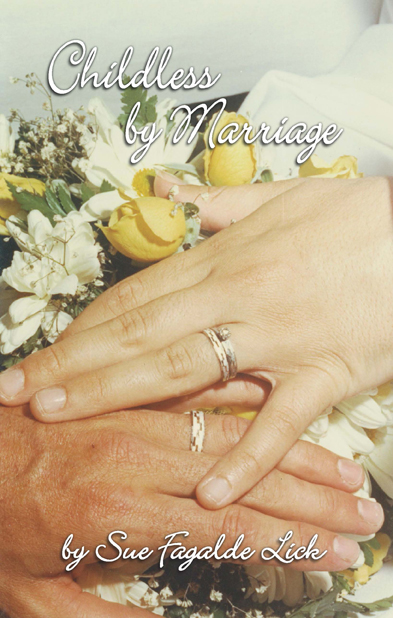
Childless by Marriage is all grown up–and we have an audiobook now

Childless by Marriage the book is a teenager. Published in 2012, it’s not the bestseller I had hoped it would be, but it’s a good book, and I hope it has helped people understand what it’s like to not have children because your partner is unable or unwilling to make babies with you.

It has lots of siblings now, including Love or Children: When You Can’t Have Both, which includes some of the most popular posts and comments from the blog between 2007 and 2020. There have been many new posts since then, and they are all archived on this site.

When Amazon offered a chance to create an audiobook version of Childless by Marriage, I went for it. The voice is computer-generated, not mine, but I like the way she sounds. This makes the book accessible to people who are visually impaired or who simply prefer to listen to books while they do other things.

While I was listening to the audio version, following along with a printed copy of the book, I discovered typos and words left out or misspelled. I was horrified. Typos in books drive me crazy, so I had to fix them. I spent many hours doing that last month. I am happy to report that I have now corrected and updated all versions, print, Kindle ebook, and audio. You can buy them at Amazon.com, or your favorite bookstore can order the print book through Ingram.

One good thing about producing books instead of children, especially in the computer age, is that you can go back and fix your mistakes. You can’t do that with most things in life. If for some reason you can’t have the children you wanted, you can’t go back to the original Word file and change the story of your life. Instead, you’re forced to make a tough decision. Do you accept the situation as it is, find a new partner, adopt, or try IVF? Do you settle for fur-babies or open a daycare? Do you grieve the loss or embrace the childfree life, or a little of both?

As I mentioned a couple weeks ago, I will soon stop blogging here. By the end of August, I will have shared 900 posts. If the book is a teenager, the blog is old enough to move out and live on its own. It’s time to let it go.

All of the posts will remain online for you to read, along with my resource page, bibliography, and updates on all things childless. I plan to create an index, but meanwhile, you can search right here on this page for whatever interests you.

I will also continue my Childless by Marriage Facebook page and would love to see some of you there.

At this point, my life is so far past the question of whether or not to have children that it’s time to let younger writers take the stage. There are many of them with so many more books, blogs, podcasts and support groups for people who are childless not by choice.

We even have a World Childless Week, hosted by Stephanie Joy Phillips, which offers tons of talks and workshops, readings, and resources, all online. This year it will be Sept. 15-21. Visit https://worldchildlessweek.net for more information.

One of the strongest voices in the no-kids community is Jody Day, founder of Gateway Women and author of Living the Life Unexpected. She has passed her own torch to Katy Seppi, who continues the work as The Childless Collective. Meanwhile, Jody has turned her attention to childless older women and is doing wonderful work there. Read her newsletter and subscribe to her Substack, https://jodyday.substack.com.

Not so long ago, people didn’t talk about childlessness. If someone didn’t have children, there were whispers about possible infertility—poor thing—but no one said anything out loud about it. But times have changed, and our numbers have risen. We can share our stories without shame so people can know and understand. No more secrets.

Question: As I prepare my last few posts, what do you wish someone had told you as you faced the possibility of life without children?


Nomo Crones meet next week

Jody Day hosts quarterly “Childless Elderwomen Fireside Chats” with women from all over the world. I have been lucky to participate in most of them. We have discussed everything from aging alone to how to deal with obnoxious questions about our parenting status. On Saturday, June 28, at 11 a.m. Pacific time, we “NomoCrones,” as Jody calls us, will discuss the often-buried subject of menopause and life beyond our fertile years. As always, it will be lively, with plenty of laughter and probably some tears. You can register to join us anonymously at bit.ly/gwe-meno. You will not be seen or heard, but the chat is always a big part of the festivities. The session will be recorded, so you can listen live or whenever you want to.

Meanwhile, Jody has published a terrific post about menopause and aging without children. You can read it here.


If you want to know what I’m up to these days, visit my “Can I Do It Alone?” Substack at https://suelick.substack.com or on Facebook at https://www.facebook.com/suelick

Childless Author’s Novels were Full of Children

I just finished reading Good Wives by Louisa May Alcott. I didn’t know until after I finished reading it that it’s actually the second half of Little Women, first published in the UK as a separate book. I found it in an antique store and was thrilled to get it. This copy could be a hundred years old. There’s nothing printed in its pages to tell me, but it is definitely older than my mother’s 1930s editions of Little Women and Little Men

Today, when we hear “Good Wives,” we think of the American TV show “The Good Wife,” starring Juliana Margulies, but that’s a whole other story. Alcott’s tale is about Jo, Meg, Beth, and Amy March in their teens and early 20s when they were looking for husbands and preparing to start their own families. Jo, if you recall, wanted to be a writer and was stubbornly independent. For a while it looked as if she would never marry. She turned down her friend Laurie, saying she didn’t love him in a romantic way. He took his disappointment to Europe, where he ran into Jo’s sister Amy. Romance ensued and they were married. 

Back home, Meg had married John and produced twins, a boy and a girl named Demi and Daisy. Amy had a girl she named Beth after her sister who died. Jo, seeking adventure, went off to be a governess in New York. There, she met Professor Fritz Baehr, who was a bit old and had no money but was so darned loveable. After much back and forthing, they married, started a school for boys, and had two sons of their own. As for her writing, Jo might get back to it later. As the book ends, the family is all together, the March parents surrounded by their wonderful grandchildren. 

Did anyone ever say, “Nope, I’d rather not have children”? Not a hint of it. Did anyone suffer from infertility? If so, no one spoke of it. There was a line that may have been trying to subtly indicate that after the twins, Meg had a miscarriage. But one did not even use the word pregnant in those days, so it’s not clear. Also, we don’t know why Amy and Laurie only have one child.

Alcott was writing in Massachusetts shortly after the Civil War. Was it a simpler time, or was it just a time when more was hidden? Birth control and abortion were not something families like the Marches discussed or considered using. Papa March was a preacher after all. We have to assume that these fictional characters did not have sex outside of marriage, although people in the 1800s had the same biological urges as we do. 

I suspect the challenges we deal with now were the same then except no one was allowed to talk about it. What if Laurie or John or Fritz said, no, I really don’t want to be bothered with children? What if Jo had stuck to her writing and said I don’t have time be a mom

When I was a kid, I wanted to be Jo so bad. I tried to dress like her and speak like her, or at least how I imagined she would dress or speak. I hadn’t seen any of the Little Women movies. I walked around with my little notebook scribbling stories and poems all day long. As for my future as a possible wife and mother, a “good wife,” I wasn’t there yet. A few years on, I discovered the attraction of boys and assumed the rest would follow. Ha. Here I am by myself in a motel in Yreka, California with no companion, no children left behind or to visit when I arrive in the Bay Area, no grandchildren to swarm around me as they did around Marmee. 

I used birth control throughout my first marriage because my husband wasn’t ready. My second husband had had a vasectomy because he had already had his children. Again, what if Fritz had said no to Jo? What if he had his own children and insisted those would have to be enough? 

What is a good wife? In the world of Little Women, it was a woman who devoted herself to husband, home, and children while the husband provided financial support. And sperm. Today, there are many other variations of the husband-wife relationship that can also be called good. It should be noted that Louisa May Alcott herself never married or had children.

Think about how very recent our childless-by-marriage situation really is. Birth control was not available to everyone until the 1970s. Abortion was illegal in most of the U.S. until 1973. Back then, out-of-wedlock pregnancies were a huge scandal. Pregnant girls were hidden away and forced to give their babies up for adoption.  Things have changed over the last 50 years, which is not so long a span of time, a time when women like me grew up reading Little Women and grew old streaming “Sex and the City” over HBOMax. I think we are still figuring it all out. In the future, perhaps a whole new definition of family, marriage and “good wives” or “good husbands” will develop. Community parenting perhaps or more people not getting married? What do you think it will be like in 2070?

Meanwhile, what do we do now? How do we balance our varying wants and needs? If this were a church blog, I’d say pray. But I know we all have different beliefs. Search your hearts and minds to find the answer to “What should I do about marriage and children?” and ask yourself, “Can I live with things the way they are? If not, what should I do?”

When you read old books or watch shows set in earlier times, do you think about their views about marriage and children? Does it look easier or not so easy at all? 

***

A reader emailed me recently suggesting that we host a Zoom meeting so we can talk about childlessness more spontaneously and get to know each other. I know many of you need to be anonymous, but what do you think? Would you like to Zoom with us sometime this summer? 

Processing…
Success! You're on the list.

Who can you talk to about being childless?

Worry about whether or not you will ever have children is eating you alive. Your spouse/partner refuses to talk about it or gets angry when you mention it. I suppose that’s why so readers seek refuge here. You say: Finally, someone I can talk to. I can’t say these things to anyone else.

I’m glad to provide a place where you can say whatever you need to say and get responses from people who understand, but are you sure there’s no one else in your life whom you can talk to about being childless by marriage?

Looking back on my own life, I didn’t share my concerns. I didn’t want to worry my parents. I didn’t have a sister. While I was married to my first husband, my brother was working full-time and going to law school; kids weren’t on his agenda yet. And my second husband, Fred, was my brother’s friend long before I met him.

I didn’t have the kind of intimate friends I could share this with. In my 20s, I wasn’t that worried about it. There was so much time ahead of us. We were all busy with college and careers.

When I was married to Fred and the prospect of never having children was becoming a certainty, who did I talk to? Not my parents. Not my new sister-in-law, who didn’t understand. Not my brother, who had two children now. I didn’t discuss it with my friends. I could have. Some of them didn’t have children either, but I didn’t share my pain with them. I gave them terse comments: we can’t, I can’t, I have three stepchildren, I hate Mother’s Day . . . I didn’t let them into my grief and worry or my desire to hold a baby and watch it grow into a person.

I have been in counseling off and on throughout my life for depression and anxiety. But honestly none of my therapists have understood what it’s like. They blew off my concerns with easy answers: enjoy other people’s kids, embrace your stepchildren, find other outlets for your energy.

Talk to a priest? Priests are programmed to promote parenthood. Anything less is a sin.

Of course, the person we most need to talk with about this, our partner, is often the most difficult. You tiptoe into the subject, trying not to make him/her angry, trying not to put a kink in your relationship. Nagging doesn’t help (I really, really, really want to have a baby). Neither does silent anger or crying in the bathroom (What’s wrong? Nothing!)

I think we’re embarrassed sometimes to admit that we have this problem with our relationship. We’re afraid of glib answers and misunderstandings. We’re afraid our friends and family will start to hate the person we love. They might urge us to leave him or her. They might start to treat our partner badly. Or they might take his/her side when there shouldn’t be sides, just everyone loving and trying to work things out.

I have a best friend now with whom I can discuss my childlessness, even though she’s a mother and grandmother. She knows how touchy I am about babies, knows I wish I had a family like she does. She has her own family issues, which we discuss freely. But where was she when I was in the thick of it?

I look back now at friends I used to have. I could have talked to them. I should have talked to them. This is an awfully big burden to carry alone, especially if you’ve reached the point where you’re thinking about leaving the relationship because you don’t want to live a life without children.

I have said way more about me than I intended to. What about you? Who in your life can you be totally honest with and talk about your no-baby situation? Do your parents or siblings know how you feel? Is there a friend, an aunt, or a co-worker with whom you can talk it out?

I was just thinking about soap operas. I haven’t watched them for a long time, but it seems the characters have all the heavy conversations that we never have in real life. Sipping wine, their hair perfectly coiffed, they let it all out, weep big TV tears, and hug as the scene fades to a commercial.

Can we do that? What do you think? Is there someone you can talk to, someone you can trust to not blab your secrets or stomp all over your feelings? It’s so important to let it out. The dog is good, but she’s spayed, and she doesn’t speak English.

Let’s talk about talking about it. I welcome your comments.

**************

Next week’s post will be number 700! I’m thinking we should have a party. Details to follow.